My Opa had 5 children between 1932 and 1943. Two of them, Babs at age 5 and Willem as a baby (after whom I am named) succumbed to diphtheria in May of 1944, the War perhaps partially contributing to the state of nutrition, vaccination (or lack thereof) and medicine available.
After peace was restored to Europe, my Opa was called in 1946 to minister at a different church this time in the town of Driesum, where he stayed until he retired in the early 70's. He continued to actively preach however and for a time had his Sundays completely booked, up to two years in advance.
He went home in October of 1985.
Monday, November 29, 2004


Oranje NBS

Because of my Opa's position as a pastor of a church, it made for a natural fit into a resistance network. The privilege and prestige that came with being a minister, the already-in-place network of ministers and others throughout the towns and village of Holland made for a good starting point for an underground resistance.
As the war ended, there was suddenly a lack of governing structure, and the resistance members maintained some semblance of control. This arm band was worn by those in the resistance to identify them as someone in charge.
My Mom Remembers:
The Germans were going through our village looking for members of the resistance.
Normally everyone received advance warning of a sweep, were able to slip out the back and seek out a place of temporary refuge until they could return to their homes. This time was no exception. The trouble was my grandfather was quite sick and was not able on this occasion to make himself scarce. He had no alternative but to leave it in God’'s hands.
As the Germans finished up their sweep, there were three houses in a row between two bridges left unsearched, an oversight.
Normally everyone received advance warning of a sweep, were able to slip out the back and seek out a place of temporary refuge until they could return to their homes. This time was no exception. The trouble was my grandfather was quite sick and was not able on this occasion to make himself scarce. He had no alternative but to leave it in God’'s hands.
As the Germans finished up their sweep, there were three houses in a row between two bridges left unsearched, an oversight.
Wednesday, November 24, 2004
Agents of Grace

In a similar albeit much less extreme vein of resistance to that of The White Rose and Dietrich Bonhoeffer the Dutch Churches felt they had to say something to the Nazi Government. This is a copy of the letter they sent. It is a good example of how one's faith demands action, especially in the face of tyranny. As we look back from our comfortable chairs, the events seem remote, tame and maybe even a little romantic. But if you ever have a chance to see either the movie The White Rose or Bonhoeffer: Agent of Grace, you may be able to better appreciate the gravity of the situation. A gravity that caused lives to be sacrificed on both sides of the war.
The body of this letter is as follows (translated):
Dr. Seyss-Inquart, Federal Minister
Reichs Commissioner for the Dutch Occupied Territory, The Hague
The Christian churches in the Netherlands have already deemed it necessary to complain to your Excellency during the years of occupation, particularly in the matter of the Jewish citizens of our country, but there is something so terrible happening now that we cannot possibly refrain from addressing a word to your Excellency in the name of our Lord.
We have already deplored various acts of the occupying forces which are incompatible with the spiritual foundation of our people who, since their beginning have at least tried, with their Government, to live according to God's word.
In the last few weeks, a sterilization process has begun in so-called mixed marriages. God, however, who created heaven and earth and whose commandment applies to all people, and to whom your Excellency must also be accountable one day, has said to the people: Be
fruitful and multiply (Gen. 1:28). Sterilization means a physical and spiritual mutilation, which is in direct opposition to the divine commandment that we shall not dishonour, hate, injure or kill our fellow man. Sterilization means a desecration of the divine commandment as well as human rights. It is the latest consequence of an anti-Christian and genocidal racial doctrine, an excessive presumption, a world and life philosophy which undermines a truly Christian and humane existence and, ultimately, renders it impossible.
You, Excellency, are currently the highest political authority in the Netherlands. You are entrusted, as the matter now lies, to maintain law and order in this land; entrusted not only by the leader of the German Reich, but also by God, through an inviolable dispensation as proclaimed by the Christian church in this world. The commandments of this God and Ruler of the entire world apply to you, as to all people, but to you especially, because you have accepted this high position.
Therefore, in the name of God, and based on His word,' the Christian churches in the Netherlands say to your Excellency: It is the duty of your Excellency to prevent this despicable sterilization procedure.
We have no illusions. We know full well that we can hardly expect that your Excellency will heed the voice of the church, meaning the voice of the Gospel, meaning the voice of God. But that which one cannot expect as a human being, one may hope for in the Christian faith. The living God has the power to bend even your Excellency's heart to conversion and obedience. We therefore ask God to bless your Excellency and our suffering people.
May 1943
Sunday, November 21, 2004
Regulations
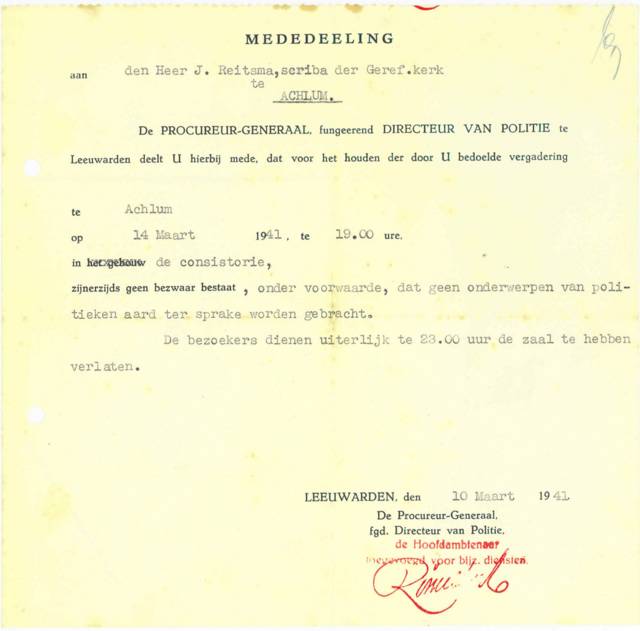
This is a permit allowing the council of my Opa's church to meet during weekday evenings. The council was responsible for overseeing the church operation. The permit allows for meetings on church related matters, but meetings could not go longer than 11pm and political topics were not to be discussed.
Wednesday, November 17, 2004
Bicycle Permit
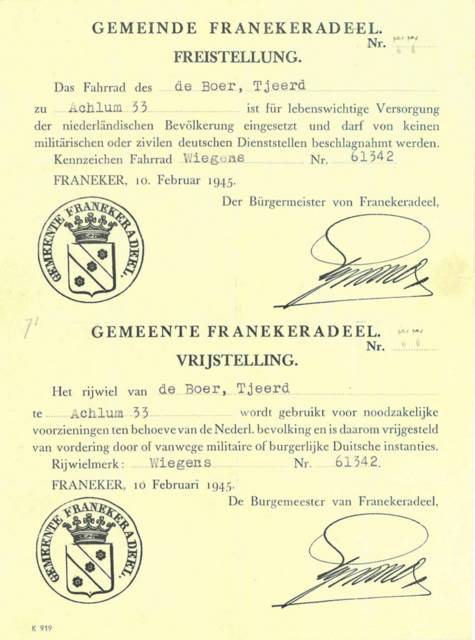
Because of his position as a pastor the Nazi Government also allowed my Opa to keep his bicycle. Most bicycles were confiscated for Germans to use, unless they were well hidden. The permit shown above was the official paper granting him the privilege to be able to keep his bike.
Tuesday, November 16, 2004
Opa

Grandfather in Dutch is 'Opa', consequently I had an Opa rather than a grandpa. Since my Opa lived all his life in Holland, and I have lived most of mine in Canada, I only met him a few times when either he was visiting Canada or I was visiting Holland.
My Opa was born in Den Haag on the 2nd of December 1902. He attended the Free University of Amsterdam and after graduating was ordained as a pastor in the Gereformeerde Kerk (Reformed Church) of Achlum, a small village in the province of Friesland in 1930. He spent the years of World War II in that village.
Pictured here is his permit from the Nazi Government allowing him to continue working as a pastor in Holland. As the war progressed, every able bodied male in Holland was required to go to Germany to work in aid of the German war effort.
Thursday, November 11, 2004
Remembrance Day
Today is Remembrance Day in Canada.
As a Canadian and as a Son of Dutch parents who were children during World War II, I have instilled in me a very base honour for the Canadians who participated in liberating Holland. The few times I have visited Holland I was taken aback by the deep respect I felt from Dutch strangers when they realized I was Canadian.
I pray thanks for soldiers everywhere, but also to all those who have fought injustice, who fought and continue to fight in ways other than as soldiers. Over the next few posts I would like to share a few mementos from my maternal grandfather, a member of the resistance in Holland during WWII.
Lastly I as a proud Canadian, I leave you with but one word. Vimy
As a Canadian and as a Son of Dutch parents who were children during World War II, I have instilled in me a very base honour for the Canadians who participated in liberating Holland. The few times I have visited Holland I was taken aback by the deep respect I felt from Dutch strangers when they realized I was Canadian.
I pray thanks for soldiers everywhere, but also to all those who have fought injustice, who fought and continue to fight in ways other than as soldiers. Over the next few posts I would like to share a few mementos from my maternal grandfather, a member of the resistance in Holland during WWII.
Lastly I as a proud Canadian, I leave you with but one word. Vimy
Tuesday, November 09, 2004
Toilet Training

Tuesday, November 02, 2004
Passion Awareness

While I was in Japan, the movie The Passion of the Christ made a smallish splash. There was talk about it, people had questions about it. There was literature available in Japanese about the movie, and the Grapevine Cell Church received a stack of little booklets that could be handed out. One day Dan and I went out and about (I said that with my Canadian accent) stuffing mailboxes with these booklets and an invitation to the next Alpha course starting in the neighborhood. We planned carefully where to hand these out, and ended up distributing these upstream (as far as traffic flow) from the Abeno Room, which was where the Alpha was going to be held. As we were walking the back streets and stuffing mailboxes we occasionally met people and personally handed one to them as well (if they wanted one). The procedure, a slight bow of the head and a spoken 'Doozo'. Doozo has a kind of broad 'please' interpretation. Because of the population density of the Abeno area, we handed out about 1000 booklets (all we had) and never really got more than about a 10 minute walk from out starting point.
Saturday, October 23, 2004
Equipped
My two weeks of Equipped and my two days of abbreviated Orientation (which I did in a backwards fashion from the norm) were chocked full of imparted wisdom, from many other people to me. We stayed at a retreat centre out in the woods in Snohomish Washington (a little north of Seattle) called The Turning Point. We commuted to the Crista Campus where we borrowed boardroom space from World Concern for our daily download of information. I longed for the technology available to Neo in the Matrix, just plug me in and download straight to my memory. I worked at being a sponge. By the end of each day I was mentally tired and especially by the end of the two weeks. It has been a while since I have done that much continuous learning, I've become used to short seminars or single classes usually in my field of expertise.
We had a large quantity of high quality people teaching us and leading us. Some were my fellow learners, others were staff of Mission to Unreached People and others were experts in their field. They gave us a lot of material and a foundation of knowledge in their areas of expertise. Miriam Addeny, a doctor of anthropology who teaches at both Seattle Pacific University and Regent College, gave us a little expertise in culture acquisition. We were taught by Ellen Errigton of Wycliffe Bible translators (she is currently teaching at Trinity Western University) who taught us about language and cultural acquisition. These are a few examples of about 10 or so instructors who came to equip us with some of the things we will need. With only a few exceptions, all of our instructors have spent significant time overseas and speak to us not only with wisdom and knowledge but with the practicality that comes from experience.
We had a large quantity of high quality people teaching us and leading us. Some were my fellow learners, others were staff of Mission to Unreached People and others were experts in their field. They gave us a lot of material and a foundation of knowledge in their areas of expertise. Miriam Addeny, a doctor of anthropology who teaches at both Seattle Pacific University and Regent College, gave us a little expertise in culture acquisition. We were taught by Ellen Errigton of Wycliffe Bible translators (she is currently teaching at Trinity Western University) who taught us about language and cultural acquisition. These are a few examples of about 10 or so instructors who came to equip us with some of the things we will need. With only a few exceptions, all of our instructors have spent significant time overseas and speak to us not only with wisdom and knowledge but with the practicality that comes from experience.
Nervousness
About a month ago, I had the privilege of giving a meditation in our afternoon service. I hesitate to say I preached because I was a bundle of nerves as I walked up to the front of the sanctuary. My delivery was amateurish and I didn't project my voice. I suppose it is to be expected because it was the first time, but I was disappointed in myself. I received lots of encouragement after the service though so I take that highly into consideration. Following are my notes, which I followed almost word for word.
The Suffering Father
Scripture Luke 15:11-32
Text: Romans 11:11-12
For the sermon this evening I will attempt to keep in mind two distinct cultures. The North American Culture we live in and the Japanese culture I served in. I will try to look at the parable through both sets of eyes and come to a cross culture conclusion. Unfortunately I know much less about Japanese than North American culture, but I’ll do my best to try a bring across a taste of the Japanese worldview.
Let me begin by saying that it is often a good idea to let a story stand on its own. To let the listener or reader ponder it and feel how it fits them. As an example, when we tell a joke and someone doesn’t get the joke, we have to go through a long explanation, and the joke loses its funniness. Rather a good story is like a painting left for us to take in and interpret for ourselves.
Well I will try not to “explain” the story, but I will try to help you to understand it. I will try my best to provide you with important background information and insight into the parable. In this way we get a better picture of the story.
The story starts out in verse 11 with: “there was a father who had two sons”. This is an important line, There was a father who had two sons.
Right off the bat in verse 12 we have the younger son asking for his “share of the estate”. To the original listeners this would be an appalling thing to say, it would be a grievous request. Unheard of. Woo the audacity of that punk kid.
According to Deuteronomy the inheritance would be 1/3 of the fathers estate. The Law also mandated that the father would retain control of the land. The father was not to sell it, but neither was the heir.
Next in verse 13, we pick up with the younger son getting together all he had to set off for a far away place where he lived fast and loose.
We see that the younger son did sell the land he was not supposed to sell, compounding the insult against his father. He first insulted the father by asking for his inheritance and then he has the gall to sell that inheritance.
Verse 14 and 15 find the young son alone and penniless, reduced to the lowly task of feeding pigs. This is especially insulting to Jewish ears who realize that feeding pigs is against the law, further reinforcing their disdain of the lad.
The young son separated himself from his father. He wanted freedom, thinking that freedom was to be independent.
He finally comes to the conclusion in vs. 17 that freedom is really found with his father and decides to head back home in hopes of becoming a hired hand.
We pick up in verse 20b.
“But while he was still a long way off, the father saw him; he ran to his son, threw his arms around him and kissed him.
The father was waiting. The father (an oldish man) ran to his son.
This is a point that oriental people will understand better than North Americans. A man over the age of thirty would not run. It would be a most undignified thing for a man of status to do. Even if he was in a great hurry, he should carry on in a sedate and stately manner. You can just see the inhabitants of the village shaking their heads yet again at the odd things that happen in this family.
But the father runs.
Even before the son has time to tell his father about the plans he has been thinking about since he started back home, the father throws his arms around his returning son.
The son manages to get in that he is no longer worthy to be called a son, but the father responds with action.
He commands his servants to bring out his best robe to put on his son. He has a ring put on his son’s finger and sandals on his feet. The fattened calf is prepared for a big to do.
Killing the fattened calf means that the whole village would be invited to the party. The calf is too large to be eaten by just the family and since the meat would spoil quickly, it all had to be eaten.
The robe would most likely be the robe the father wore on grand occasions, this is another point that the oriental listener or reader would assume. As the villagers came to the party they would see the newly returned son wearing the robe. The robe would be a symbol of acceptance to the father and because of that there would be reconciliation between the son and the people of the village.
The ring would be the family signet ring, the ring with which documents were signed. In North America we always use our signature as our mark, but in the oriental world everyone uses a specialized seal. In Japan they are finely carved and great care goes into choosing just the right marks for the seal.
The son also gets a pair of sandals, and these set him apart from the slaves, because sons wore something on their feet while slaves went barefoot.
The celebration commences. Can you imagine. The whole village has turned out for the party. It is the place to be. Everyone is enjoying the plentiful food, enjoying the atmosphere, the hospitality of the host, People are making music, and others are dancing. It would be grand to join in and share in the merriment.
But now the older son turns up. He has been working in the fields, and didn’t yet know about his brother’s return. He turns up at the party wondering what is going on, and asks a servant to find out what is going on. He finds out that his kid brother had the nerve to turn up at the family home. The older son’s heart becomes angry and he refuses to join the party.
It would have been the custom, that the older son would not only join the party but take charge of the party, greeting guests, making sure everyone has food and wine, he would show joy at his brother’s return and treat him as the guest of honour.
But; the father is insulted yet again.
For the second time that day the father humiliates himself in front of the villagers and pleads with his older son to come in and join the party.
The father could have coerced the older son. He could have reminded the older son of his social obligations, he could have given him a lecture about his duty. This would be just the right button to push for an oldest Japanese son. Appealing to his sense of duty and honour.
But what would the father gain? He wants his son not a servant.
The story ends with the father talking to the oldest son, we are left hanging. Does the older son return to the party? Or does he leave in a huff.
Section 2
Quite often when we read a good story we tend to identify with one of the characters in the story. It is not necessarily the same story character for each reader, sometimes there are several characters with which we can identify. I think the same holds true with this story. I would say there are three main characters in this story to identify with. There may be one or two of you in the crowd this evening who identify with the pig farmer, but we will leave him for another day. In the meantime the three main players/characters are the younger son, the older son and the father. Most of us will have some empathy for each of the three characters, we can see their point of view, but when we look at this story in its context of the bible we usually empathize with one character most of all.
Taking the story at face value there may be Christian parents who worry about their children and identify with the father. Digging a little deeper many of us will identify with the younger son, having experienced the state of once being lost and now being found. In Japan I found out that most people identify with the older son. They can relate to his unquestioning loyalty and duty, the way he always stuck by the family. They can relate to him being ticked off by the younger brother leaving, shirking his responsibilities, and they can relate to the way the older son felt when his younger brother returned home and was welcomed straightaway back into the family.
The older son’s refusal to join the celebration however results in another break of relationship with the father that is almost as great as the break in relationship we saw at the beginning of the story.
The central part of this story is neither of the sons but rather the father. The father suffered while his young son went astray. He watched and waited for him, and was so ready to receive him that he knew his son was coming back while still a long way off. The father suffered the loss of his young son until he came back, but the older son was also lost. And now the father is out watching and waiting. Suffering again while he awaits the return of the older son.
What do the robe, the ring, the sandals and the fattened calf mean? The father is celebrating the restoration of a broken relationship. He was not suffering all those days because of the loss of 1/3 of his estate. For that the son could have made restitution over a period of time. But a new relationship cannot be earned. It can only come as a free gift from the father.
The son could not become a servant. That would imply that he could earn his way back into his father’s good graces.
As Paul writes in Ephesians 2:8-9
For it is by grace you have been saved, through faith – and this not from yourselves, it is the gift of God – not by works, so that no one can boast.
Just by looking at the traditional name of this parable “the prodigal son” we can gain an insight to the use of this parable. Too often preaching on this parable (probably the best known of all the parables) focuses on the negative, on the lost ness of the son rather than on the shining nugget of grace that is central to the story.
We can understand from this parable that the father is God our heavenly father. His two sons are Israel and the Gentiles. The older son is Israel and God pleads with him to accept his younger brother. The younger son is the Gentile Christians. These are God’s two sons, and in Jesus’ parable we see how God approaches them. He loves them both, he does not favour one over the other. The actions of the two sons cause the father to suffer, but he waits full of grace for them to return of their own free will.
This story is about the grace of God. For us as the younger son we were saved by God’s grace through faith and it is extended for all who have not yet come to know Christ. Our father was waiting with open arms for the first son to come home and is now waiting for the second son to come home.
With this in mind we must graciously proclaim the gospel to all cultures and peoples, weather in North America or Japan. God will be faithful in making the seeds grow. The grace of God transcends all cultures and God is sovereign over all cultures. We can rely upon him to be waiting with open arms.
The Suffering Father
Scripture Luke 15:11-32
Text: Romans 11:11-12
For the sermon this evening I will attempt to keep in mind two distinct cultures. The North American Culture we live in and the Japanese culture I served in. I will try to look at the parable through both sets of eyes and come to a cross culture conclusion. Unfortunately I know much less about Japanese than North American culture, but I’ll do my best to try a bring across a taste of the Japanese worldview.
Let me begin by saying that it is often a good idea to let a story stand on its own. To let the listener or reader ponder it and feel how it fits them. As an example, when we tell a joke and someone doesn’t get the joke, we have to go through a long explanation, and the joke loses its funniness. Rather a good story is like a painting left for us to take in and interpret for ourselves.
Well I will try not to “explain” the story, but I will try to help you to understand it. I will try my best to provide you with important background information and insight into the parable. In this way we get a better picture of the story.
The story starts out in verse 11 with: “there was a father who had two sons”. This is an important line, There was a father who had two sons.
Right off the bat in verse 12 we have the younger son asking for his “share of the estate”. To the original listeners this would be an appalling thing to say, it would be a grievous request. Unheard of. Woo the audacity of that punk kid.
According to Deuteronomy the inheritance would be 1/3 of the fathers estate. The Law also mandated that the father would retain control of the land. The father was not to sell it, but neither was the heir.
Next in verse 13, we pick up with the younger son getting together all he had to set off for a far away place where he lived fast and loose.
We see that the younger son did sell the land he was not supposed to sell, compounding the insult against his father. He first insulted the father by asking for his inheritance and then he has the gall to sell that inheritance.
Verse 14 and 15 find the young son alone and penniless, reduced to the lowly task of feeding pigs. This is especially insulting to Jewish ears who realize that feeding pigs is against the law, further reinforcing their disdain of the lad.
The young son separated himself from his father. He wanted freedom, thinking that freedom was to be independent.
He finally comes to the conclusion in vs. 17 that freedom is really found with his father and decides to head back home in hopes of becoming a hired hand.
We pick up in verse 20b.
“But while he was still a long way off, the father saw him; he ran to his son, threw his arms around him and kissed him.
The father was waiting. The father (an oldish man) ran to his son.
This is a point that oriental people will understand better than North Americans. A man over the age of thirty would not run. It would be a most undignified thing for a man of status to do. Even if he was in a great hurry, he should carry on in a sedate and stately manner. You can just see the inhabitants of the village shaking their heads yet again at the odd things that happen in this family.
But the father runs.
Even before the son has time to tell his father about the plans he has been thinking about since he started back home, the father throws his arms around his returning son.
The son manages to get in that he is no longer worthy to be called a son, but the father responds with action.
He commands his servants to bring out his best robe to put on his son. He has a ring put on his son’s finger and sandals on his feet. The fattened calf is prepared for a big to do.
Killing the fattened calf means that the whole village would be invited to the party. The calf is too large to be eaten by just the family and since the meat would spoil quickly, it all had to be eaten.
The robe would most likely be the robe the father wore on grand occasions, this is another point that the oriental listener or reader would assume. As the villagers came to the party they would see the newly returned son wearing the robe. The robe would be a symbol of acceptance to the father and because of that there would be reconciliation between the son and the people of the village.
The ring would be the family signet ring, the ring with which documents were signed. In North America we always use our signature as our mark, but in the oriental world everyone uses a specialized seal. In Japan they are finely carved and great care goes into choosing just the right marks for the seal.
The son also gets a pair of sandals, and these set him apart from the slaves, because sons wore something on their feet while slaves went barefoot.
The celebration commences. Can you imagine. The whole village has turned out for the party. It is the place to be. Everyone is enjoying the plentiful food, enjoying the atmosphere, the hospitality of the host, People are making music, and others are dancing. It would be grand to join in and share in the merriment.
But now the older son turns up. He has been working in the fields, and didn’t yet know about his brother’s return. He turns up at the party wondering what is going on, and asks a servant to find out what is going on. He finds out that his kid brother had the nerve to turn up at the family home. The older son’s heart becomes angry and he refuses to join the party.
It would have been the custom, that the older son would not only join the party but take charge of the party, greeting guests, making sure everyone has food and wine, he would show joy at his brother’s return and treat him as the guest of honour.
But; the father is insulted yet again.
For the second time that day the father humiliates himself in front of the villagers and pleads with his older son to come in and join the party.
The father could have coerced the older son. He could have reminded the older son of his social obligations, he could have given him a lecture about his duty. This would be just the right button to push for an oldest Japanese son. Appealing to his sense of duty and honour.
But what would the father gain? He wants his son not a servant.
The story ends with the father talking to the oldest son, we are left hanging. Does the older son return to the party? Or does he leave in a huff.
Section 2
Quite often when we read a good story we tend to identify with one of the characters in the story. It is not necessarily the same story character for each reader, sometimes there are several characters with which we can identify. I think the same holds true with this story. I would say there are three main characters in this story to identify with. There may be one or two of you in the crowd this evening who identify with the pig farmer, but we will leave him for another day. In the meantime the three main players/characters are the younger son, the older son and the father. Most of us will have some empathy for each of the three characters, we can see their point of view, but when we look at this story in its context of the bible we usually empathize with one character most of all.
Taking the story at face value there may be Christian parents who worry about their children and identify with the father. Digging a little deeper many of us will identify with the younger son, having experienced the state of once being lost and now being found. In Japan I found out that most people identify with the older son. They can relate to his unquestioning loyalty and duty, the way he always stuck by the family. They can relate to him being ticked off by the younger brother leaving, shirking his responsibilities, and they can relate to the way the older son felt when his younger brother returned home and was welcomed straightaway back into the family.
The older son’s refusal to join the celebration however results in another break of relationship with the father that is almost as great as the break in relationship we saw at the beginning of the story.
The central part of this story is neither of the sons but rather the father. The father suffered while his young son went astray. He watched and waited for him, and was so ready to receive him that he knew his son was coming back while still a long way off. The father suffered the loss of his young son until he came back, but the older son was also lost. And now the father is out watching and waiting. Suffering again while he awaits the return of the older son.
What do the robe, the ring, the sandals and the fattened calf mean? The father is celebrating the restoration of a broken relationship. He was not suffering all those days because of the loss of 1/3 of his estate. For that the son could have made restitution over a period of time. But a new relationship cannot be earned. It can only come as a free gift from the father.
The son could not become a servant. That would imply that he could earn his way back into his father’s good graces.
As Paul writes in Ephesians 2:8-9
For it is by grace you have been saved, through faith – and this not from yourselves, it is the gift of God – not by works, so that no one can boast.
Just by looking at the traditional name of this parable “the prodigal son” we can gain an insight to the use of this parable. Too often preaching on this parable (probably the best known of all the parables) focuses on the negative, on the lost ness of the son rather than on the shining nugget of grace that is central to the story.
We can understand from this parable that the father is God our heavenly father. His two sons are Israel and the Gentiles. The older son is Israel and God pleads with him to accept his younger brother. The younger son is the Gentile Christians. These are God’s two sons, and in Jesus’ parable we see how God approaches them. He loves them both, he does not favour one over the other. The actions of the two sons cause the father to suffer, but he waits full of grace for them to return of their own free will.
This story is about the grace of God. For us as the younger son we were saved by God’s grace through faith and it is extended for all who have not yet come to know Christ. Our father was waiting with open arms for the first son to come home and is now waiting for the second son to come home.
With this in mind we must graciously proclaim the gospel to all cultures and peoples, weather in North America or Japan. God will be faithful in making the seeds grow. The grace of God transcends all cultures and God is sovereign over all cultures. We can rely upon him to be waiting with open arms.
Monday, October 18, 2004
The Turning Point

This is a picture of The Turning Point, a retreat center in Snohomish Washington. This is where I have been holed up for the last two weeks. Following this post is a virtual explosion (not a real explosion) of blogging. Some I had written in the last two weeks, some I wrote today while awaiting my flight. (And you can read more about that as well).
Sunday, October 17, 2004
Stupid Stress
My flight left at 12:30 on the nose, and I arrived at the gate at what I thought was 12:00. I missed my flight by seconds. I saw the flight attendant close the door. I got myself booked on a later flight (about 12 hours later), and then had to spend time killing time. I did a little writing to help me a) kill time and b) relieve the stress that the closed door caused.
I get annoyed every time I pass by gate A6. That is the one my flight left from. Right by this gate there is an interesting piece of mechanical art, which normally would really capture my interest and attention. But it is very annoying because it is in a state of extremely poor working order, and only the stupid annoying bell is working, so every time I hear the bell I get annoyed. And every time I hear the lady announce the names for the people who have not checked into their flight, or any other announcement for that matter, I get annoyed because I don't think they called my name. These things all remind me of how stupid I was and it makes me really annoyed. I would love to take a hammer to that stupid bell and put it out of its misery. That would be quite satisfying although probably only until the stupid lady made another stupid announcement. How annoying.
I get annoyed every time I pass by gate A6. That is the one my flight left from. Right by this gate there is an interesting piece of mechanical art, which normally would really capture my interest and attention. But it is very annoying because it is in a state of extremely poor working order, and only the stupid annoying bell is working, so every time I hear the bell I get annoyed. And every time I hear the lady announce the names for the people who have not checked into their flight, or any other announcement for that matter, I get annoyed because I don't think they called my name. These things all remind me of how stupid I was and it makes me really annoyed. I would love to take a hammer to that stupid bell and put it out of its misery. That would be quite satisfying although probably only until the stupid lady made another stupid announcement. How annoying.
The Big Ol Californians
As part of my group I have a few Californians taking missions training with me. They tend to throw in the phrase big ol when describing something. Ruth was telling me about the two big ol does that have been seen in and around the area. I've seen them a couple of times and I couldn't say weather or not they are old, but they don't look all that big, at least compared to some I've seen in and around Ontario. Joseph is seven and he came with his parents and sister and great aunt. He was telling me about this big ol banana slug that he and his dad had seen down the road by the big ol house. He certainly was right about the size. I've seen one that was about 6 inches long. I have absolutely no idea how to tell how ol they are though, and so I'll defer to young Joseph's expertise on that score. And the houses around here I would consider on the large side of the housing scale, but also the houses in this area tend to be quite new so I would say the ol doesn't apply. A day or two later we had cream of chicken soup with wild rice for lunch at the cafe, and Robin thoroughly enjoyed the big ol chunks of chicken in her soup. I had a bowl too, and while I would say the chunks of chicken were pretty big considering the norm for chicken soup, they tasted quite fresh, tender and juicy to me. So to sum up this big ol blog, I think I have yet to grasp the proper use of big ol.
LAX
I flew into LAX from Toronto on my roundabout way to Seattle (saving me a couple of cnotes by doing so). The pilot dropped the plane lightly on the runway after two tries that were a little too high, and then immediately hit the brakes hard, the engines roaring with reverse thrust to slow the plane down. Perhaps there was less runway to play with after taking the extra time to execute the light landing. I was instructed to catch the shuttle bus for terminal four to get to terminal three. We cruised around the airport tarmac at a sedate pace, taking in the sights of large aircraft taxiing by and the myriad of aircraft support vehicles running seemingly random routes around the tarmac. The LAX fire crew was testing their equipment, emitting a cloud of mauvish purple smoke as we went by. It was an enjoyable ride for one who loves to watch machinery at work. We arrived at our destination which the shuttle bus driver said was terminal three and the only reason I believed him was because I saw a couple of Alaska Airlines aeroplanes sitting at their gates waiting to take on passengers, one of which would be me. The two other people and I got off the bus and wondered which way to go, there were no signs, no arrows, not even a "that looks like where I need to go" sort of door. The security guard, looking more like someone who is about to sell me something illegal than an airport officer, sneakily pointed me toward a line of concrete barriers that looked like they lead into the underground bowels of the airport. I sceptically following his finger and turning the corner expecting again to see something self-explanatory found a dead end with nothing more than a back door. I tried it but it was locked. Hmm. The security guard came up, swiped his security card through the reader and opened the door for us, muttering something about going up the stairs. I climbed the narrow stairwell upward and encountered a gaggle of baggage-laden passengers waddling the other way. Squeezing by I emerged through yet another door guarded by a woman in uniform to find myself at the gate I was looking for. Good thing the flight was delayed or I would have been more panicy than I usually am.
A brush with customs
As I was leaving Toronto I had this engaging conversation with the US customs officer.
How long are you going for?
Two weeks.
What are going to be doing?
I am going to be doing some training.
Where do you live?
Georgetown ON
Training for what?
I'm going to be training to be a missionary.
Where are you going to be going?
Japan.
Really? Two weeks? That's not very long to become a missionary.
Well I suppose that's not all the training there is to it.
Have you read the book Shogun?
Yes I have.
That's good then you know how they treat missionaries over there. Have a good trip.
Two nuggets of wisdom in that exchange of words in my humble estimation. Being a missionary is more than two weeks of training and it is more than ten years of training. It is a daily commitment to training. Reading and studying God's word everyday is necessary to being a successful missionary. It is quite possibly the only necessary ingredient to being a successful missionary. Everything else grows on that foundation. Second, when a missionary is on the front lines of the battle, it is fraught with danger. But that holds true whether we engage in a missional way of life anywhere in the world, including our home.
How long are you going for?
Two weeks.
What are going to be doing?
I am going to be doing some training.
Where do you live?
Georgetown ON
Training for what?
I'm going to be training to be a missionary.
Where are you going to be going?
Japan.
Really? Two weeks? That's not very long to become a missionary.
Well I suppose that's not all the training there is to it.
Have you read the book Shogun?
Yes I have.
That's good then you know how they treat missionaries over there. Have a good trip.
Two nuggets of wisdom in that exchange of words in my humble estimation. Being a missionary is more than two weeks of training and it is more than ten years of training. It is a daily commitment to training. Reading and studying God's word everyday is necessary to being a successful missionary. It is quite possibly the only necessary ingredient to being a successful missionary. Everything else grows on that foundation. Second, when a missionary is on the front lines of the battle, it is fraught with danger. But that holds true whether we engage in a missional way of life anywhere in the world, including our home.
Friday, October 08, 2004
On the road again
Since Monday I have been going to classes in Seattle to help equip me to be a missionary. I had hoped to blog everyday about my experiences and what I am learning, but as it turns out I am staying at a retreat house where they don't have a phone let alone internet access. I have managed to get a little time and can pop in this short blog, but that will have to do. I promise a bunch of posts the moment I get back (well perhaps a little sleep first). It turns out this learning stuff makes one quite tired, my brain is usually full before the end of the day. I am here for two weeks for the classes.
Friday, October 01, 2004
Jhouse
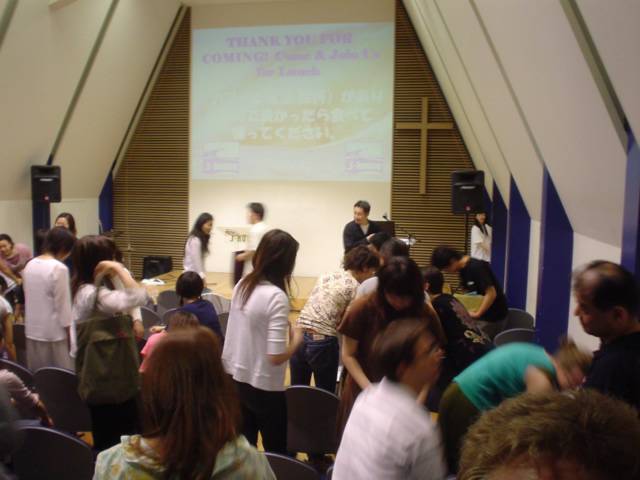
One of the churches I frequented on Sunday mornings while I was in Japan was Jhouse. Jhouse is a church which is Pentecostal in the nature of it's worship and who's demographic is very young. I always felt quite old when I was at the service. It was a real joy to see so many young Japanese church goers because in many cases the general church goer is on the older side of 35. Jhouse runs their services mostly in Japanese, but simultaneous interpretation into English is offered via earphone. In this manner I was still able to glean something of the sermons.
Friday, September 24, 2004
Things I love.
"when there is a question as to whether a man is good, one does not ask what he believes, or what he hopes, but what he loves."Augustine of Hippo.
"What do you love?" It is in that question and the spiritual dynamics implicit in its answer that belief and behavior are woven together.Steven Garber ("Fabric of Faithfulness, p. 22).
A few years ago I audited a course at ICS called Worldview Foundations. My professor was Gideon Strauss. On his blog of Sept 13, he references my list of things I love.
The list was written in 2002 and I would like to amend the list, but only slightly. There are definitely a few things and someone that I need to add.
Some of the things I love in no particular order
Aukje, learning, people, tools, woodworking, my family, Nuevo Suyapa, San Salvador, God, 7th Heaven (the ski runs at Blackcomb), books, of all sorts, especially by CS Lewis, JRR Tolkein, William Gibson, Douglas Adams Hitchhiker's guide to the galaxy trilogy of five books, and Tom Clancy, computers, sailing and sailboats, creating things, imagination, Playa La Zunganera, paintings, sketching, adventures, the sound of children playing on the playground, fall rains, trees, the stillness of newly falling snow, the smell of a bakery, cars - particularly Vdubs, soccer (the beautiful game), standing on top of a mountain, making others happy, The Simpson’s, all my friends, parts of Osaka especially the castle, Berlin, Vancouver, the harbour in Rotterdam, machines (especially big powerful ones, and simple effective ones), movies, especially The Matrix, and The Fifth Element, sculpture, the Group of 7, fixing things, the sound of babbling brooks, Georgian Bay (especially around Tobermory), the kingdom of God, canoeing, Algonquin Park, moose, Africa, music of all sorts except Country and Western, watching people create/perform live, art galleries, Science Fiction, Jackie Chan's hokey martial arts movies, history, teaching, the students I get to know through teaching, the Bible, Fernie, the tingling of the spine you get when something you’ve created is so obviously great, MC Escher, cycling, camping, hiking, Star Trek, the vastness of the ocean, good humour and laughing, thunder storms, pond hockey, the beauty of the woods, driving, helping others, spring breezes and last and what should be least chocolate.
Subscribe to:
Posts (Atom)