Monday, January 17, 2005

An Osaka Steet Scene


It has come to my attention that there has been an oversight. The Sekime photolog has not had a photo for quite some time. In order to rectify the problem I have chosen a photograph for you to enjoy. It does not have much significance other than the fact that it actually is a photograph. It was taken on my way from the YWCA where I went to language school to Umeda where I could catch the train or the subway.

Friday, January 14, 2005

Language in Japan

In Japan your run-of-the-mill dog says "Wong wong wong".

Wednesday, January 05, 2005

Retro-blogging

As I've posted before, I attended the Worldview Foundations course at the ICS a couple year's ago.

One of my assignments was to write a short scenario, on what the world would look like in fifty years, if the world developed as a culturally hardened, high conflict world. It had to written from the point of view of my home church.


I thoroughly enjoyed writing it and like the story myself. I thought I'd republish it in this forum.


The Georgetown CRC - 2052 in a culturally hardened, high conflict world.

Juanita looked up at the moon obscured by a cloud of pollution. Remembering the moon of her childhood, a pristine white orb, she thought it was a shame it had been sold to Microsoft-Hyundai-ING. The company had moved their entire global operations to the moon including employees and they had brought in as much commercial and cultural support as they deemed necessary. She thought that in spite of the pollution it would be a nice place to live, far removed from the trouble here on earth. Maybe she could live on the far side of the moon with the Mennonites. It would be nice to meet the people who send the automated relief re-entry drones. She was thankful for the food and clothing that they provided.

GCRC with it's long tradition of local and overseas justice work had tried
to stem the tide of Muslim domination by sending some people to the Islamic
Republic, a large Muslim state encompassing most of the northern part of the African continent. The people had been forced into the south of Africa along with most other Christians who had been unable to exist with in the Shari'a Law harshly enforced throughout the state. The Islamic Republic had built up their military and political power. One thing the Muslims never seemed to be short of was funds.

They had however been desperately short of food. At a time when it was difficult to stop them, they had sent well-equipped armies and farmers to Western Canada and Ontario looking for fertile land and fresh water supplies. Well-guarded military farms were efficiently set up and shortly thereafter the food supply line to Northern Africa was instituted. The Canadian army had fought with their legendary valiance but could not compete with the shear numbers of Muslims willing to die for their cause. Once the area had been secured, Muslims from all around North America as well as from Africa had gravitated to the area, setting up commercial support and populating the area, living like Kings from the wealth generated off the land.

But that was 15 long years ago. Since the fall of the Muslim Empire the country was no longer the super power it once was, and had degenerated to civil uprisings and quarrelling amongst Muslim factions. At the same time the dictator of the day had taken to sending "Jihad cells" to what they determined to be strategic pressure points around the globe.

She turned her attention back to the present situation. There were rumours of another raid perhaps this time by one of the infamous Jihad cells. Since the fall of the Muslim Empire the people who had been forced underground had begun to resist with better cohesion in this area of Muslim control. She was an advance scout and had to stay all but invisible while uploading observed troop movements to the local server.

She turned her thoughts back to home. Most communities had gone into hiding in order to survive. The Georgetown CRC had literally gone underground and currently most of its congregation made their home in one of the newly opened but now disused silver mines in the area. There was still Silver here but the fighting had made mining superfluous, and the mines were very easy to defend. Working in the resistance wasn't a nine to five job. She hoped she would make it to the afternoon service tomorrow. It would be good to see people again.

Saturday, January 01, 2005

It is difficult to type with one arm behind your back

I am being coerced, blackmailed as it were into writing this blog.
Through many years as a Mapleleafs fan, (since the 1977 playoffs when the Leafs beat the Islanders in 7) I have never seen a player quite like Mats Johan Sundin, his skill as a hockey player and his poise as the Leaf Captain are better than any that I've seen in a MapleLeaf uniform. So Kudos to you Mats, your Mom is calling you for some Campbell's soup and I'm calling you to get your derriere back on the ice for some good old fashioned barn burning hockey, just like the good ol' days.
There you go M.A

Wednesday, December 22, 2004

I am accepted

December 22, 2004

I received in the mail today my acceptance letter from MUPs.

Dear Will:

On behalf of the Board, staff, and missionaries of Mission to Unreached Peoples, I want to take this opportunity to officially welcome you to this ministry. Your application, references, interview, and psychological profiles have been carefully reviewed, and we have agreed to accept you as approved Mission to Unreached Peoples personnel.

You are now officially ready to begin preparations for your anticipated ministry to serve in Japan. Your preparation for ministry and transitioning your life in Japan will be a team joint effort between yourself and the guidance provided for you from your field leadership.

Will, we are standing with you, asking God through the power of the Holy Spirit to help you. Getting ready to leave to do the work God has prepared for you is an exciting time, full of anticipation and hope. But it can also be a difficult period, one full of hectic activity, doubts and testing.

I encourage you to begin go over the information contained in this packet. You will need to know the information it contains, and we need to be able to rely on the fact that you've read, studied, and are acting on it. We will be contacting you shortly to personalize your preparation and departure paperwork. It is imperative you know the steps necessary to take in order to reach your ultimate goal of service in the Great Commission in the wisest and best-prepared manner possible. Kathy Cranston will be your Candidate Manager, and will be your primary contact here in the office. Please especially take the Planning Steps suggestion and establish a prayer support group now and begin meeting with them weekly.

In the interval between now and the time you leave, it will be important for us to build good personal relationships with each other. Whenever you have a question or a need, please contact the office. You are joining a fellowship of like-minded brothers and sisters in Christ. We will be praying for you regularly and desire to stay in close touch with you.

You will need to begin to put together a mailing list and to think about sending out prayer letters for supporters and prayer partners now. It will be important to start to build this base of prayer and financial support and to keep your supporters informed about what's happening with your preparations.

It is important for you to know that, in accordance with IRS regulations, any funds sent on your behalf will be kept in an account in your name until you leave. Should you decide for any reason not to proceed with this ministry, the money received would then be channeled in consultation with you to other workers or projects. It normally cannot be returned.
Please also read through the Policy Manual carefully. We will contact you shortly to develop your personal budget and to finalize the Financial Agreement and Overseas Service Agreement.

I will be sending a letter, along with a copy of this letter, to your pastor telling him of your acceptance and suggesting ways in which we might work with your church and missions committee as they support you both with prayer, encouragement, and finances. We ask that you continue in discussion with your church about their involvement in your calling to this overseas ministry. This is a team effort, and we pray that your church will feel a part of this ministry in a vital way. We are available to help you with fundraising and with your relationship to your home church in any way that we can.

What an opportunity we have to be a part of the Great Commission and to work together to reach the unreached! Ahead of you is adventure, growth in faith, some setbacks and trials, but the Lord will be with you through it all. Remember, "Be strong in the Lord and in His mighty power. Put on the full armor of God so that you can take your stand against authorities, against the powers of darkness, and against spiritual forces of evil... therefore put on the full armor of God." We are praying that our Father will be helping you as you prepare spiritually, materially, and financially for this new adventure of faith.

"Praise be to God and thanks be to Him who always leads us in triumphal procession in Christ and through us spreads everywhere the fragrance of the knowledge of Him. For we are to God the aroma of Christ among those who are being saved and those who are perishing (II Corinthians 2:14-15)."

As always, should you ever have questions, concerns, or just want to discuss or pray about what is happening during the preparation process, don't hesitate to give me a call or to write. May our heavenly Father bless you with peace, joy, and power during this time as you rest in Him! (Philippians 4:19)

For the Kingdom,

Jeff Kwon
Director of Mobilization

Monday, December 20, 2004

Pondering Authentic Glory to God

A few days ago I was pondering. I am posting this more for my own future benefit than for anything else, but of course anyone is welcome to peruse it.
Authentic praise is heartfelt. Too often in the NA church the praise comes more in the form of rhetoric. I think there may be too much rhetoric in our churches today. But that aside; when we praise God in North America, culture, language, and our worldview all come very much into play. Our praise is generally offered in context of these things. We generally praise God in our own language, we use words that are meaningful to us based on our experiences with life as well as with church.

How does one offer authentic praise in Japan? What is authentic praise from a Japanese standpoint?
I suppose they might offer up or elevate values they hold near and dear to their own hearts, core values and transfer them to God? For an example I think a core value in the Japanese culture is honour. Being honourable is especially important to the average Japanese person. So if God was infinitely and perfectly honourable, honour personified, that would constitute mighty high praise indeed, in the eyes and heart and soul and mind of a Japanese person. Or as a second example loyalty. Loyalty is another core value I think. So if God were worshipped as being omnipotently loyal, that too would be beautiful in the estimation of a Japanese person.

In our culture (North American, European) we have developed a large body of music and songs, poetry and stories, pop culture and high culture, over the years in praise to God.

But in Japan the cultural legacy is one built without God. Can we export our resources into a Japanese culture very different from that of western culture and expect that to be meaningful? How is authentic praise being generated in Japan? How can it be developed? How can we help in developing it?

Can there be Japanese music that is Christian? Can there be Japanese Literature that is praiseworthy? How can we develop art that is glorifying to God in Japan?

As a rookie missionary I look with not a little trepidation at the mountain that needs to be moved. I need to learn not to focus on the mountain but on the Mover. That is key to success, and to my well being.

Sunday, December 12, 2004

Weaving Belief and Behavior

Sometime ago Gideon Strauss blogged about Makoto Fujimura, an artist of Japanese decent, a Christian, who is the owner of some impressive credentials.

Robert Kushner (an artist and critic) has written:
The idea of forging a new kind of art, about hope, healing, redemption, refuge, while maintaining visual sophistication and intellectual integrity is a growing movement, one which finds Fujimura's work at the vanguard.

In the past I have wondered about Japan, it's lack of Christianity historically and the impact that has on art and music and culture in general. Conversely, how do we as Christians impact Japan with music, art, and culture.
I think it is a good thing to have people like Makoto sama in the world today, as we seek to proclaim the gospel in Japan.

Monday, November 29, 2004

Homeward Bound

My Opa had 5 children between 1932 and 1943. Two of them, Babs at age 5 and Willem as a baby (after whom I am named) succumbed to diphtheria in May of 1944, the War perhaps partially contributing to the state of nutrition, vaccination (or lack thereof) and medicine available.
After peace was restored to Europe, my Opa was called in 1946 to minister at a different church this time in the town of Driesum, where he stayed until he retired in the early 70's. He continued to actively preach however and for a time had his Sundays completely booked, up to two years in advance.
He went home in October of 1985.

Oranje NBS


Because of my Opa's position as a pastor of a church, it made for a natural fit into a resistance network. The privilege and prestige that came with being a minister, the already-in-place network of ministers and others throughout the towns and village of Holland made for a good starting point for an underground resistance.
As the war ended, there was suddenly a lack of governing structure, and the resistance members maintained some semblance of control. This arm band was worn by those in the resistance to identify them as someone in charge.

My Mom Remembers:

The Germans were going through our village looking for members of the resistance.

Normally everyone received advance warning of a sweep, were able to slip out the back and seek out a place of temporary refuge until they could return to their homes. This time was no exception. The trouble was my grandfather was quite sick and was not able on this occasion to make himself scarce. He had no alternative but to leave it in God’'s hands.

As the Germans finished up their sweep, there were three houses in a row between two bridges left unsearched, an oversight.

Wednesday, November 24, 2004

Agents of Grace


In a similar albeit much less extreme vein of resistance to that of The White Rose and Dietrich Bonhoeffer the Dutch Churches felt they had to say something to the Nazi Government. This is a copy of the letter they sent. It is a good example of how one's faith demands action, especially in the face of tyranny. As we look back from our comfortable chairs, the events seem remote, tame and maybe even a little romantic. But if you ever have a chance to see either the movie The White Rose or Bonhoeffer: Agent of Grace, you may be able to better appreciate the gravity of the situation. A gravity that caused lives to be sacrificed on both sides of the war.

The body of this letter is as follows (translated):


Dr. Seyss-Inquart, Federal Minister
Reichs Commissioner for the Dutch Occupied Territory, The Hague

The Christian churches in the Netherlands have already deemed it necessary to complain to your Excellency during the years of occupation, particularly in the matter of the Jewish citizens of our country, but there is something so terrible happening now that we cannot possibly refrain from addressing a word to your Excellency in the name of our Lord.

We have already deplored various acts of the occupying forces which are incompatible with the spiritual foundation of our people who, since their beginning have at least tried, with their Government, to live according to God's word.

In the last few weeks, a sterilization process has begun in so-called mixed marriages. God, however, who created heaven and earth and whose commandment applies to all people, and to whom your Excellency must also be accountable one day, has said to the people: Be
fruitful and multiply (Gen. 1:28). Sterilization means a physical and spiritual mutilation, which is in direct opposition to the divine commandment that we shall not dishonour, hate, injure or kill our fellow man. Sterilization means a desecration of the divine commandment as well as human rights. It is the latest consequence of an anti-Christian and genocidal racial doctrine, an excessive presumption, a world and life philosophy which undermines a truly Christian and humane existence and, ultimately, renders it impossible.

You, Excellency, are currently the highest political authority in the Netherlands. You are entrusted, as the matter now lies, to maintain law and order in this land; entrusted not only by the leader of the German Reich, but also by God, through an inviolable dispensation as proclaimed by the Christian church in this world. The commandments of this God and Ruler of the entire world apply to you, as to all people, but to you especially, because you have accepted this high position.

Therefore, in the name of God, and based on His word,' the Christian churches in the Netherlands say to your Excellency: It is the duty of your Excellency to prevent this despicable sterilization procedure.

We have no illusions. We know full well that we can hardly expect that your Excellency will heed the voice of the church, meaning the voice of the Gospel, meaning the voice of God. But that which one cannot expect as a human being, one may hope for in the Christian faith. The living God has the power to bend even your Excellency's heart to conversion and obedience. We therefore ask God to bless your Excellency and our suffering people.

May 1943

Sunday, November 21, 2004

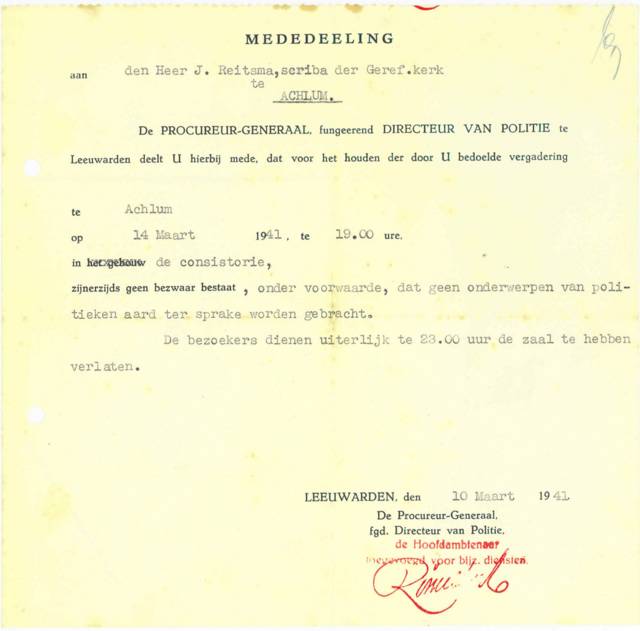
Regulations


This is a permit allowing the council of my Opa's church to meet during weekday evenings. The council was responsible for overseeing the church operation. The permit allows for meetings on church related matters, but meetings could not go longer than 11pm and political topics were not to be discussed.

Wednesday, November 17, 2004

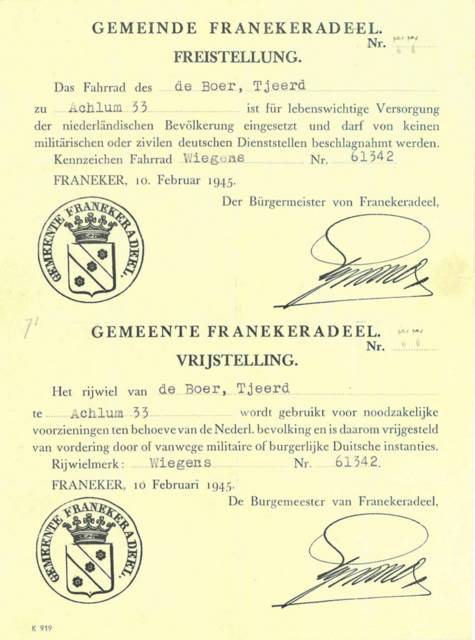
Bicycle Permit


Because of his position as a pastor the Nazi Government also allowed my Opa to keep his bicycle. Most bicycles were confiscated for Germans to use, unless they were well hidden. The permit shown above was the official paper granting him the privilege to be able to keep his bike.

Tuesday, November 16, 2004

Opa


Grandfather in Dutch is 'Opa', consequently I had an Opa rather than a grandpa. Since my Opa lived all his life in Holland, and I have lived most of mine in Canada, I only met him a few times when either he was visiting Canada or I was visiting Holland.
My Opa was born in Den Haag on the 2nd of December 1902. He attended the Free University of Amsterdam and after graduating was ordained as a pastor in the Gereformeerde Kerk (Reformed Church) of Achlum, a small village in the province of Friesland in 1930. He spent the years of World War II in that village.
Pictured here is his permit from the Nazi Government allowing him to continue working as a pastor in Holland. As the war progressed, every able bodied male in Holland was required to go to Germany to work in aid of the German war effort.

Thursday, November 11, 2004

Remembrance Day

Today is Remembrance Day in Canada.

As a Canadian and as a Son of Dutch parents who were children during World War II, I have instilled in me a very base honour for the Canadians who participated in liberating Holland. The few times I have visited Holland I was taken aback by the deep respect I felt from Dutch strangers when they realized I was Canadian.

I pray thanks for soldiers everywhere, but also to all those who have fought injustice, who fought and continue to fight in ways other than as soldiers. Over the next few posts I would like to share a few mementos from my maternal grandfather, a member of the resistance in Holland during WWII.

Lastly I as a proud Canadian, I leave you with but one word. Vimy

Tuesday, November 09, 2004

Toilet Training


Here is a toilet complete with slippers. The toilet is separate from the bathroom. I had to learn how to properly use the slippers and also learn which way to pull the flush lever (big or small).

Tuesday, November 02, 2004

Passion Awareness


While I was in Japan, the movie The Passion of the Christ made a smallish splash. There was talk about it, people had questions about it. There was literature available in Japanese about the movie, and the Grapevine Cell Church received a stack of little booklets that could be handed out. One day Dan and I went out and about (I said that with my Canadian accent) stuffing mailboxes with these booklets and an invitation to the next Alpha course starting in the neighborhood. We planned carefully where to hand these out, and ended up distributing these upstream (as far as traffic flow) from the Abeno Room, which was where the Alpha was going to be held. As we were walking the back streets and stuffing mailboxes we occasionally met people and personally handed one to them as well (if they wanted one). The procedure, a slight bow of the head and a spoken 'Doozo'. Doozo has a kind of broad 'please' interpretation. Because of the population density of the Abeno area, we handed out about 1000 booklets (all we had) and never really got more than about a 10 minute walk from out starting point.

Saturday, October 23, 2004

Equipped

My two weeks of Equipped and my two days of abbreviated Orientation (which I did in a backwards fashion from the norm) were chocked full of imparted wisdom, from many other people to me. We stayed at a retreat centre out in the woods in Snohomish Washington (a little north of Seattle) called The Turning Point. We commuted to the Crista Campus where we borrowed boardroom space from World Concern for our daily download of information. I longed for the technology available to Neo in the Matrix, just plug me in and download straight to my memory. I worked at being a sponge. By the end of each day I was mentally tired and especially by the end of the two weeks. It has been a while since I have done that much continuous learning, I've become used to short seminars or single classes usually in my field of expertise.
We had a large quantity of high quality people teaching us and leading us. Some were my fellow learners, others were staff of Mission to Unreached People and others were experts in their field. They gave us a lot of material and a foundation of knowledge in their areas of expertise. Miriam Addeny, a doctor of anthropology who teaches at both Seattle Pacific University and Regent College, gave us a little expertise in culture acquisition. We were taught by Ellen Errigton of Wycliffe Bible translators (she is currently teaching at Trinity Western University) who taught us about language and cultural acquisition. These are a few examples of about 10 or so instructors who came to equip us with some of the things we will need. With only a few exceptions, all of our instructors have spent significant time overseas and speak to us not only with wisdom and knowledge but with the practicality that comes from experience.

Nervousness

About a month ago, I had the privilege of giving a meditation in our afternoon service. I hesitate to say I preached because I was a bundle of nerves as I walked up to the front of the sanctuary. My delivery was amateurish and I didn't project my voice. I suppose it is to be expected because it was the first time, but I was disappointed in myself. I received lots of encouragement after the service though so I take that highly into consideration. Following are my notes, which I followed almost word for word.

The Suffering Father

Scripture Luke 15:11-32
Text: Romans 11:11-12

For the sermon this evening I will attempt to keep in mind two distinct cultures. The North American Culture we live in and the Japanese culture I served in. I will try to look at the parable through both sets of eyes and come to a cross culture conclusion. Unfortunately I know much less about Japanese than North American culture, but I’ll do my best to try a bring across a taste of the Japanese worldview.

Let me begin by saying that it is often a good idea to let a story stand on its own. To let the listener or reader ponder it and feel how it fits them. As an example, when we tell a joke and someone doesn’t get the joke, we have to go through a long explanation, and the joke loses its funniness. Rather a good story is like a painting left for us to take in and interpret for ourselves.

Well I will try not to “explain” the story, but I will try to help you to understand it. I will try my best to provide you with important background information and insight into the parable. In this way we get a better picture of the story.

The story starts out in verse 11 with: “there was a father who had two sons”. This is an important line, There was a father who had two sons.

Right off the bat in verse 12 we have the younger son asking for his “share of the estate”. To the original listeners this would be an appalling thing to say, it would be a grievous request. Unheard of. Woo the audacity of that punk kid.

According to Deuteronomy the inheritance would be 1/3 of the fathers estate. The Law also mandated that the father would retain control of the land. The father was not to sell it, but neither was the heir.

Next in verse 13, we pick up with the younger son getting together all he had to set off for a far away place where he lived fast and loose.

We see that the younger son did sell the land he was not supposed to sell, compounding the insult against his father. He first insulted the father by asking for his inheritance and then he has the gall to sell that inheritance.

Verse 14 and 15 find the young son alone and penniless, reduced to the lowly task of feeding pigs. This is especially insulting to Jewish ears who realize that feeding pigs is against the law, further reinforcing their disdain of the lad.

The young son separated himself from his father. He wanted freedom, thinking that freedom was to be independent.

He finally comes to the conclusion in vs. 17 that freedom is really found with his father and decides to head back home in hopes of becoming a hired hand.
We pick up in verse 20b.
“But while he was still a long way off, the father saw him; he ran to his son, threw his arms around him and kissed him.

The father was waiting. The father (an oldish man) ran to his son.

This is a point that oriental people will understand better than North Americans. A man over the age of thirty would not run. It would be a most undignified thing for a man of status to do. Even if he was in a great hurry, he should carry on in a sedate and stately manner. You can just see the inhabitants of the village shaking their heads yet again at the odd things that happen in this family.

But the father runs.

Even before the son has time to tell his father about the plans he has been thinking about since he started back home, the father throws his arms around his returning son.

The son manages to get in that he is no longer worthy to be called a son, but the father responds with action.

He commands his servants to bring out his best robe to put on his son. He has a ring put on his son’s finger and sandals on his feet. The fattened calf is prepared for a big to do.

Killing the fattened calf means that the whole village would be invited to the party. The calf is too large to be eaten by just the family and since the meat would spoil quickly, it all had to be eaten.
The robe would most likely be the robe the father wore on grand occasions, this is another point that the oriental listener or reader would assume. As the villagers came to the party they would see the newly returned son wearing the robe. The robe would be a symbol of acceptance to the father and because of that there would be reconciliation between the son and the people of the village.
The ring would be the family signet ring, the ring with which documents were signed. In North America we always use our signature as our mark, but in the oriental world everyone uses a specialized seal. In Japan they are finely carved and great care goes into choosing just the right marks for the seal.
The son also gets a pair of sandals, and these set him apart from the slaves, because sons wore something on their feet while slaves went barefoot.

The celebration commences. Can you imagine. The whole village has turned out for the party. It is the place to be. Everyone is enjoying the plentiful food, enjoying the atmosphere, the hospitality of the host, People are making music, and others are dancing. It would be grand to join in and share in the merriment.

But now the older son turns up. He has been working in the fields, and didn’t yet know about his brother’s return. He turns up at the party wondering what is going on, and asks a servant to find out what is going on. He finds out that his kid brother had the nerve to turn up at the family home. The older son’s heart becomes angry and he refuses to join the party.

It would have been the custom, that the older son would not only join the party but take charge of the party, greeting guests, making sure everyone has food and wine, he would show joy at his brother’s return and treat him as the guest of honour.

But; the father is insulted yet again.

For the second time that day the father humiliates himself in front of the villagers and pleads with his older son to come in and join the party.

The father could have coerced the older son. He could have reminded the older son of his social obligations, he could have given him a lecture about his duty. This would be just the right button to push for an oldest Japanese son. Appealing to his sense of duty and honour.
But what would the father gain? He wants his son not a servant.

The story ends with the father talking to the oldest son, we are left hanging. Does the older son return to the party? Or does he leave in a huff.

Section 2

Quite often when we read a good story we tend to identify with one of the characters in the story. It is not necessarily the same story character for each reader, sometimes there are several characters with which we can identify. I think the same holds true with this story. I would say there are three main characters in this story to identify with. There may be one or two of you in the crowd this evening who identify with the pig farmer, but we will leave him for another day. In the meantime the three main players/characters are the younger son, the older son and the father. Most of us will have some empathy for each of the three characters, we can see their point of view, but when we look at this story in its context of the bible we usually empathize with one character most of all.
Taking the story at face value there may be Christian parents who worry about their children and identify with the father. Digging a little deeper many of us will identify with the younger son, having experienced the state of once being lost and now being found. In Japan I found out that most people identify with the older son. They can relate to his unquestioning loyalty and duty, the way he always stuck by the family. They can relate to him being ticked off by the younger brother leaving, shirking his responsibilities, and they can relate to the way the older son felt when his younger brother returned home and was welcomed straightaway back into the family.
The older son’s refusal to join the celebration however results in another break of relationship with the father that is almost as great as the break in relationship we saw at the beginning of the story.
The central part of this story is neither of the sons but rather the father. The father suffered while his young son went astray. He watched and waited for him, and was so ready to receive him that he knew his son was coming back while still a long way off. The father suffered the loss of his young son until he came back, but the older son was also lost. And now the father is out watching and waiting. Suffering again while he awaits the return of the older son.

What do the robe, the ring, the sandals and the fattened calf mean? The father is celebrating the restoration of a broken relationship. He was not suffering all those days because of the loss of 1/3 of his estate. For that the son could have made restitution over a period of time. But a new relationship cannot be earned. It can only come as a free gift from the father.
The son could not become a servant. That would imply that he could earn his way back into his father’s good graces.

As Paul writes in Ephesians 2:8-9

For it is by grace you have been saved, through faith – and this not from yourselves, it is the gift of God – not by works, so that no one can boast.

Just by looking at the traditional name of this parable “the prodigal son” we can gain an insight to the use of this parable. Too often preaching on this parable (probably the best known of all the parables) focuses on the negative, on the lost ness of the son rather than on the shining nugget of grace that is central to the story.

We can understand from this parable that the father is God our heavenly father. His two sons are Israel and the Gentiles. The older son is Israel and God pleads with him to accept his younger brother. The younger son is the Gentile Christians. These are God’s two sons, and in Jesus’ parable we see how God approaches them. He loves them both, he does not favour one over the other. The actions of the two sons cause the father to suffer, but he waits full of grace for them to return of their own free will.

This story is about the grace of God. For us as the younger son we were saved by God’s grace through faith and it is extended for all who have not yet come to know Christ. Our father was waiting with open arms for the first son to come home and is now waiting for the second son to come home.

With this in mind we must graciously proclaim the gospel to all cultures and peoples, weather in North America or Japan. God will be faithful in making the seeds grow. The grace of God transcends all cultures and God is sovereign over all cultures. We can rely upon him to be waiting with open arms.

Monday, October 18, 2004

The Turning Point


This is a picture of The Turning Point, a retreat center in Snohomish Washington. This is where I have been holed up for the last two weeks. Following this post is a virtual explosion (not a real explosion) of blogging. Some I had written in the last two weeks, some I wrote today while awaiting my flight. (And you can read more about that as well).