Late last night the garbage truck came to empty the bin from the pizza joint in our building. I have never noticed how often this happens, but last night the smell invaded our little abode sneaking in our open apartment windows and the assault was successful enough to make us hold our noses.
Early in the morning, I am not sure what time these things happened but it was always dark out, I was awakened more than once by the same residual smells wafting around the apartment. I can only assume the sickly sweet yet rank odour to still be coming from the pizza garbage storage facility. And yet later in the morning I was awakened by a couple in their apartment, in the building across the street. Their apartment at the same general height as ours, as they continued their weekend long row, very noisily arguing, tipping big items over, tossing stuff around their apartment.
As I awoke from my fitful slumber this morning I felt short changed on my sleep allotment, but didn't know who to complain to about it.
Monday, June 27, 2005


Sunday, June 26, 2005
A cultural observation
It is interesting to so how a culture deals situations. In Japan it is the sunshine and the heat. As the march toward summer continues I have noted certain things. The sun umbrellas (aka parasols) are out, but only women use them. A sun umbrella is different from a rain umbrella. In Japan, beauty is seen in the whiteness of the skin, rather than the tanned ideal in North America. To that end parasols are employed to keep the sun off one's face. There are many other precautions to be taken as well. Make sure all your skin is covered (with either long sleeves or long gloves and long pants). It is best that everything is black so that it soaks up the sun rather than reflects those evil damaging rays toward a sensitive patch of exposed skin. The umbrella however can be white, so it can reflect those rays upward before they get anywhere near a person.
It is not manly to be carrying a parasol so no men ever do. However I have observed one or two using an umbrella to ward off the sun. I think the key is to use a rain umbrella, that way everyone can see that this is a one time occurrence and that you don't usually engage in such feminine acts of comfort.
It is not manly to be carrying a parasol so no men ever do. However I have observed one or two using an umbrella to ward off the sun. I think the key is to use a rain umbrella, that way everyone can see that this is a one time occurrence and that you don't usually engage in such feminine acts of comfort.
Friday, June 24, 2005
Dilemma upon Dilemma
I am wearing long black pants, socks and dress shoes. It is 31 degrees centigrade and the relative humidity is about 80%. It is not yet summer. (And yes I am wearing a shirt, but it has short sleeves). I am running late for the train by perhaps thirty seconds and I need to stop at the machine for a new K-card.
Given my state of dress and the current temperature methinks it would be inadvisable to make a dash for the train. Therein lies my dilemma. The next train is not due for another ten minutes. If I do not catch this train I will be late, but if I exert any extra energy I will be guaranteed to work up even more of a sweat.
So I ponder. Would it be better to go with a steady sustained jog or should I sprint and get it over with quickly. (With me there is probably not all that much difference between the two, but anyway).
I decide that the steady jog will leave me a little less winded and will also be slightly more socially acceptable. (It is an everyday occurrence to see people running for all manner of public transportation in Japan). (And it does not matter if you are wearing flip-flops, high heels, or dress shoes).
Update. I made the train, which fortunately was air conditioned, ahhh so nice and cool.
Oh yes, deodorant is not available in Japan.
Given my state of dress and the current temperature methinks it would be inadvisable to make a dash for the train. Therein lies my dilemma. The next train is not due for another ten minutes. If I do not catch this train I will be late, but if I exert any extra energy I will be guaranteed to work up even more of a sweat.
So I ponder. Would it be better to go with a steady sustained jog or should I sprint and get it over with quickly. (With me there is probably not all that much difference between the two, but anyway).
I decide that the steady jog will leave me a little less winded and will also be slightly more socially acceptable. (It is an everyday occurrence to see people running for all manner of public transportation in Japan). (And it does not matter if you are wearing flip-flops, high heels, or dress shoes).
Update. I made the train, which fortunately was air conditioned, ahhh so nice and cool.
Oh yes, deodorant is not available in Japan.
Thursday, June 23, 2005
The Church Lady
On Sunday, Aukje and I attended our regular Sunday Morning church, which is a small Japanese church. Nobody speaks English (apart from the two of us), so it is a genuine immersion experience for me. After church we usually eat lunch together (the whole church) and some of the church goers have fun trying out their few English phrases on me as I try out my Japanese phrases on them. After the close of the service just before lunch the topic of discussion for some of the time was me.
As much as I try not to, I always seem to arrive at church with a very red face. Not because of embarrassment but from the walk to church which usually seems to take place in the sun. Sunday was no exception, and I was perspiring. Hmm, let me be frank, I was sweating. In Japanese the word to describe me is "atsugari" which means "a person who is sensitive to [can't stand] the heat" and the antonym is "samugari".
As one of the church ladies (the moniker "church lady" carries with it a lot of baggage, especially of the Saturday Night Live variety, none of which applies to this particular church lady), was trying to come up with an English equivalent (hot-blooded might be a potential English equivalent), she told me I was a hot body. Aukje laughed (bursting my bubble) and explained to our friend what describing someone with the words "hot body" referred to. After the explanation, to make matters worse (for me), she laughed too!
C'est la vie.
As much as I try not to, I always seem to arrive at church with a very red face. Not because of embarrassment but from the walk to church which usually seems to take place in the sun. Sunday was no exception, and I was perspiring. Hmm, let me be frank, I was sweating. In Japanese the word to describe me is "atsugari" which means "a person who is sensitive to [can't stand] the heat" and the antonym is "samugari".
As one of the church ladies (the moniker "church lady" carries with it a lot of baggage, especially of the Saturday Night Live variety, none of which applies to this particular church lady), was trying to come up with an English equivalent (hot-blooded might be a potential English equivalent), she told me I was a hot body. Aukje laughed (bursting my bubble) and explained to our friend what describing someone with the words "hot body" referred to. After the explanation, to make matters worse (for me), she laughed too!
C'est la vie.
Tuesday, June 21, 2005
Lackluster blogging.
Every other Tuesday evening I teach an English class. Because of my lack of English teaching experience, it takes a significant part of the day to prepare for the class, I am apprehensive starting the day before, and it generally feels burdensome. This limits my time to blog either extensively or intelligently and all the above makes me a little grumpy.
Monday, June 20, 2005
LL
Some days I get so extremely frustrated with being unable to get a handle on the language I would like to revert to my childhood, throw a temper tantrum and maybe some other things, and then become an adult again. Stupid na keiyoshis. Stupid vocabulary. Stupid pronunciation.
Sunday, June 19, 2005
Friday, June 17, 2005
The View From Here
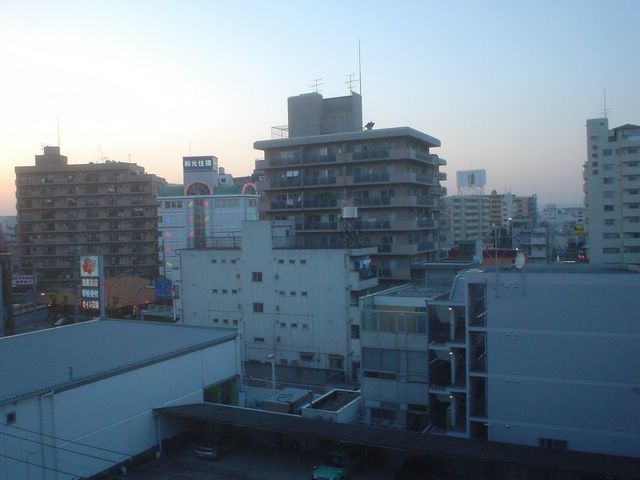
I was reflecting just a few days ago on looking out the window. My good wife thinks I have a tendency to gaze through the window.
I recalled my elementary school days. Each classroom had these big beautiful windows, picture a full wall of windows, looking out to the outside world. While sitting in class doing a tedious assignment or some other monotonous school work, the window and what was beyond always drew me. Ahhh, it is still there in my mind's eye, the glorious green of the grass and the trees, the birds chirping and warbling, the sunshine streaming through the tree branches, the soccer field practically shouting my name. It is no wonder the little box for the teachers comments on my report cards invariably declared that I was a really nice person, but tended to be a day dreamer.
These tendencies plagued me at home too, when my mother thought it high time I learned to play the piano. Our piano sat right beside the dining room picture window, looking into the one acre backyard of our country home. I could look at the black and white music and the black and white piano keys or I could turn my head and look at the same sorts of things as in school. I still cannot play the piano.
Then I thought about my career to this point and realized that I have always had a window in my office to look out. Being in the design field I could always get away with gazing out the window under the pretext that I was designing something.
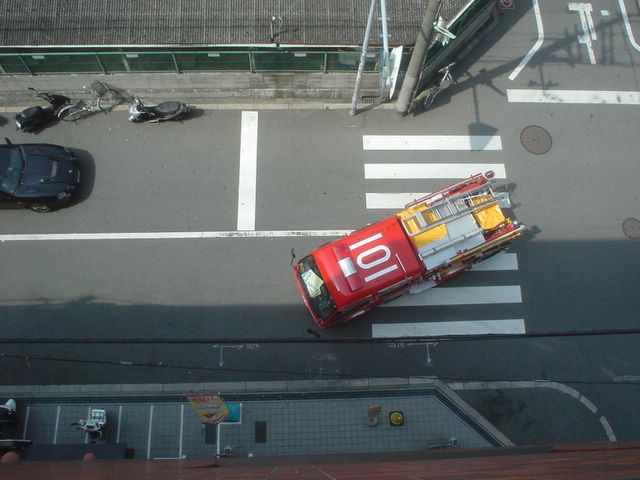
Now that I am in the mission field I find myself living in a sixth floor apartment with a view over my neighborhood. There are many ordinary things that are interesting to me. "“Look honey! A truck with kin den on the door. I think it is a Japanese hydro truck!" I find myself intrigued with such things more often. Well this blog has gone on long enough, it is high time I go and see what is up in my neighbourhood.
Thursday, June 16, 2005
Learning
I am currently working through two books on how to read the Bible as part of my MUP (my mission organization) Phase II training. (I need to put this task (the task of reading the Bible well) into my own context so I can understand what I am doing better). The books are: How to read the Bible to Hear God Speak: A study in Numbers 22-24 by Calvin G Seerveld and How to Read the Bible for all its Worth by Gordon D. Fee and Douglas Stuart.
Not everyone is a biblical scholar. I think it is much easier for a biblical scholar to exegete scripture and engage in hermeneutics than for us normal folk. So. My mother, who is a Christian I greatly respect but not a biblical scholar, still needs to read the Bible and hear God speak. My big brother is also a Christian. Although he cannot read or write and has very limited intellectual capabilities, he too needs a Bible that speaks to him in ways that he can understand. How does what I am reading apply to them, how do my mom and my brother engage in exegesis and hermeneutics? And of course how can I apply it? Oh and one more, how does this affect the one holy catholic church? As wise men have said, "Learning without applying is not learning". I just needed to step back and look at the bigger picture. Yikes! That last bit is cliche is it not?
Not everyone is a biblical scholar. I think it is much easier for a biblical scholar to exegete scripture and engage in hermeneutics than for us normal folk. So. My mother, who is a Christian I greatly respect but not a biblical scholar, still needs to read the Bible and hear God speak. My big brother is also a Christian. Although he cannot read or write and has very limited intellectual capabilities, he too needs a Bible that speaks to him in ways that he can understand. How does what I am reading apply to them, how do my mom and my brother engage in exegesis and hermeneutics? And of course how can I apply it? Oh and one more, how does this affect the one holy catholic church? As wise men have said, "Learning without applying is not learning". I just needed to step back and look at the bigger picture. Yikes! That last bit is cliche is it not?
Wednesday, June 15, 2005
The Sporting Landscape

Yesterday I went exploring on my bicycle. I toured the site of Expo 90, which is now a nice park with some of the buildings and features of the Expo still intact. It is a nice place to get away from some of the honking horns, people noise, sirens and such that invade life much of the time. (Such is the lot of anyone living in a large city). As I was cycling in the park I paused to watch some young lads in the midst of a baseball practice, one little guy could smoke an overhand pitch over the plate both faster and more accurately than I ever could. Next to it I was surprised to see a football practice going on, (I counted the number of players and they were not using Canadian rules). They were decked out like the Fighting Irish but of the 5 or 6 downs I watched the quarterback threw three interceptions. A short distance down the path I saw a rugby practice going on, and shortly their after a fine example of the beautiful game. Each one was very organized and the players all looked very competent.
Monday, June 13, 2005
A tiny bit of culture shock
This past week my stomach has been feeling a tad green, a little queasy. Fortunately there was some stomach medicine around the apt. We took a look at what we had and found just the right remedy for my symptoms. Aukje popped a little packet out of the box, and I was not surprised to see the pill(s) individually wrapped. I ripped the little packet open to pop the pill into my mouth and as I did a bit of powder spilled out. What is this? I was taken aback. Where is the pill? I am supposed to eat powder? Aukje laughed and said that most medication in Japan is in powder form. Well I got myself a cup of water, and got ready for the inevitable discomfort. I skeptically dropped the powder from the packet into my throat, which completely wicked all the moisture out of my mouth, and then drank the water. Whew. I can attest now that it seems to have worked. An interesting aside; in Canada most people "“take"” their medicine, weather it is in pill form or liquid form, but in Japan most people "“drink" their medicine, even when it is in powder form.
Saturday, June 11, 2005
See ya
Today we said sayonara to a couple of Luke 10 short-term missionaries. They have been living and working in Japan for the last nine months, learning by doing and getting a taste of missionary life. It was sad to see them go even though I had only been able to get to know them for a short two months.
I then reflected on this morning's conversation with my spouse about short-termers and their affects on people (probably initiated by the thought if their leaving).
First I thought about it from my perspective as a short term participant several different times. In the past I have landed at an airport with a small team (or on my own) and been met at the airport by the local missionaries (in several different countries). We would have a bit of orientation and then we were off to whatever is we might be doing. We generally would not see them very much during our stay and then we would get together for a debriefing. I always thought it a shame that I could not get to know them a little better, that getting to know them seemed worthwhile and that I was missing out on something.
Aukje talked about it from her perspective as a long term missionary, seeing short termers come and go. It is good to get to know short term people but a long term missionary sees many short termers go. After you have invested time into a relationship, a short termer leaves (that being the nature of a short term). As it becomes old hat to see them come and go, one does not like to have to say good bye all the time, especially when one is emotionally involved. While it is good to have short termers, it is also much easier emotionally not to get too involved.
We also talked about how the Japanese people see all these foreigners come and go. Many foreigners come to teach English in Japan and the large majority does not stay. One of the first questions a Japanese person asks is often "How long are you going to stay"? In the same vein as the long term missionary, the Japanese person who strikes up a relationship with a foreigner and invests time in it, will be disappointed as the foreigner goes back to their country. I have also found in my life that moving on to a new thing is a very different feeling than feeling left behind.
Now as Micah and Melanie return home, I wish them Godspeed on their life journey.
As we try and pick up the parts and projects that they started I hope that we can catch everything.
And I wonder how it will all work out, will we be able to fill their shoes in relationships they have started. I shall have to comfort myself with the knowledge that it is not I who am in charge of this, I just work for Him.
I then reflected on this morning's conversation with my spouse about short-termers and their affects on people (probably initiated by the thought if their leaving).
First I thought about it from my perspective as a short term participant several different times. In the past I have landed at an airport with a small team (or on my own) and been met at the airport by the local missionaries (in several different countries). We would have a bit of orientation and then we were off to whatever is we might be doing. We generally would not see them very much during our stay and then we would get together for a debriefing. I always thought it a shame that I could not get to know them a little better, that getting to know them seemed worthwhile and that I was missing out on something.
Aukje talked about it from her perspective as a long term missionary, seeing short termers come and go. It is good to get to know short term people but a long term missionary sees many short termers go. After you have invested time into a relationship, a short termer leaves (that being the nature of a short term). As it becomes old hat to see them come and go, one does not like to have to say good bye all the time, especially when one is emotionally involved. While it is good to have short termers, it is also much easier emotionally not to get too involved.
We also talked about how the Japanese people see all these foreigners come and go. Many foreigners come to teach English in Japan and the large majority does not stay. One of the first questions a Japanese person asks is often "How long are you going to stay"? In the same vein as the long term missionary, the Japanese person who strikes up a relationship with a foreigner and invests time in it, will be disappointed as the foreigner goes back to their country. I have also found in my life that moving on to a new thing is a very different feeling than feeling left behind.
Now as Micah and Melanie return home, I wish them Godspeed on their life journey.
As we try and pick up the parts and projects that they started I hope that we can catch everything.
And I wonder how it will all work out, will we be able to fill their shoes in relationships they have started. I shall have to comfort myself with the knowledge that it is not I who am in charge of this, I just work for Him.
Friday, June 10, 2005
Its true I tells ya.
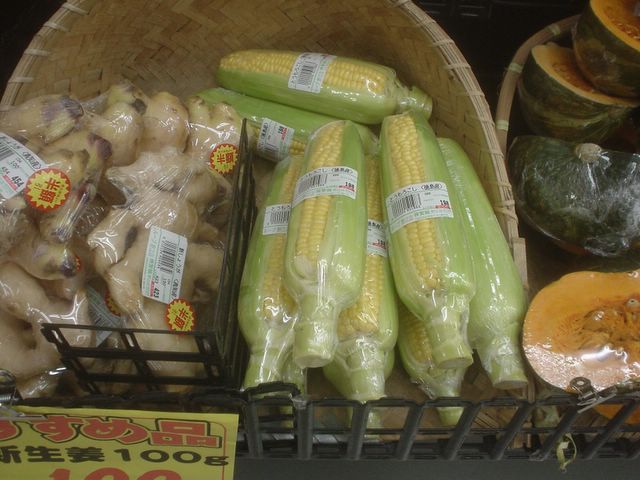
I was in the Loop (the grocery store) shopping for some supper. I decided against having a corn roast however. Corn was 198 yen per cob, that's about $2.40 Canadian each. If I could only figure out how to stash a lot of corn in my suitcase the next time I come over I could make out alright. They are soo nicely packaged though.
Thursday, June 09, 2005
Its true I tells ya.
A t-shirt with English on it, camouflage pants or shorts and a pair of glitzy high heels are an essential part of a fashion-conscious teenage girl's wardrobe in Osaka.
Wednesday, June 08, 2005
Pardieeeee!
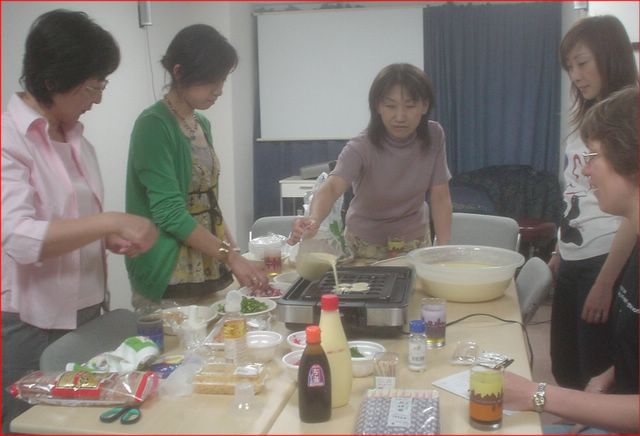
Yaki = fried and Tako = octopus.
Osakans love Takoyaki and Osaka is renown for its Takoyaki.
The ingredients for a Takoyaki party are as follows;
Gather together a group of people.
Make sure the newlyweds bring their new takoyaki maker that they received as a gift from the group of people at the party (Do not forget the cord as this is an essential part of the apparatus).
Mix up a monstrous bowl of batter that the party goers cannot possibly in their wildest dreams finish off.
Make absolutely sure you have a bunch of octopus, chopped up into small chunks, (they look somewhat reddish burgundy, kind of the colour of a radish) (and ohhh sooo delicious with their yummy little tentacle suckers sticking out of each chunk hither and thither).
Sausage and cheese can be substituted but only for foreigners who can't really handle Japanese cuisine, (one feels inferior and barbaric if one succumbs to such nonsense).
Have an assortment of toppings including but not limited to very small but very plentiful little fishes, (I kept thinking of myself as a sperm whale who takes in a huge mouthful of sea water, then strains the water out through its teeth, leaving him with a meal of fishes) (the relative sizes being the only similar thing I suppose), fine but very green seaweed slivers, fish flakes, pickled ginger, mayonnaise and takoyaki sauce.
Warm up the fryer, grease er up, and pour in the batter.
Plop in a chunk of Tako, add some toppings and let er fry.
As the batter starts to become warm, you take a toothpick like thingy (or in a pinch a single chopstick will do) and spin each one around so it becomes a ball. (This is extremely tricky at first when the inexperienced newlywed has to try his hand at it, and he is more than likely to make a fine mess of it). (It is supposed to end up looking somewhat like a chicken ball, but a little smaller and much more round).
The Takoyaki is deemed ready to eat when the outside of the batter is cooked and able to be handled with chopsticks, but the inside is still very gooey.
Share the 20 or so takoyaki amongst all the party goers, add some takoyaki sauce and/or mayonnaise, fish flakes or seaweed and enjoy!
Caution!!! They are very very hot, especially in the middle, make sure you don't stick the whole thing in your mouth right away!!!
Repeat the above process as many times as you can, (I cannot believe how these slight Japanese people can eat just as much as me), and then cook up the rest of the batter and tako to save for later.
All the while conversation and frivolity can be the order of the intervals in between mouthfuls.
After everything is cleaned up, waddle out the door and see if you can make your way home.
One final note. If you own the takoyaki greasing brush from the dollar store, be very careful when you clean it, as it is likely to come apart in your hands, rendering it virtually useless.
Saturday, June 04, 2005
Thursday, June 02, 2005
Cultural Communication Differences
The subject in the Japanese sentence is often left unsaid, and assumes that the listener or reader knows what you are talking about. It is preferred not to speak words that are apparent from the context.
From the jisho (dictionary): “In Japanese the verbal part of the sentence is the most important, and normally comes at the end. In a long sentence the listener has to wait till the end of the sentence in order to grasp the meaning. In English the grammatical subject is the most important part, and is expressed at the beginning of the sentence, and auxiliary information about the subject is imparted gradually. This makes for great clarity of meaning, whereas Japanese sentences can often produce ambiguities. But this is a product of the Japanese culture, where reticence is considered virtue and outspokenness vice.”
From the jisho (dictionary): “In Japanese the verbal part of the sentence is the most important, and normally comes at the end. In a long sentence the listener has to wait till the end of the sentence in order to grasp the meaning. In English the grammatical subject is the most important part, and is expressed at the beginning of the sentence, and auxiliary information about the subject is imparted gradually. This makes for great clarity of meaning, whereas Japanese sentences can often produce ambiguities. But this is a product of the Japanese culture, where reticence is considered virtue and outspokenness vice.”
Canadian Culture
I blogged my frustration a day or two ago. My sister sent me an e-mail in response, advising me to "Keep my stick on the ice." Ah yes, a wonderful piece of advice from a great Canadian icon Red Green.
Wednesday, June 01, 2005
Ooishii desu!!
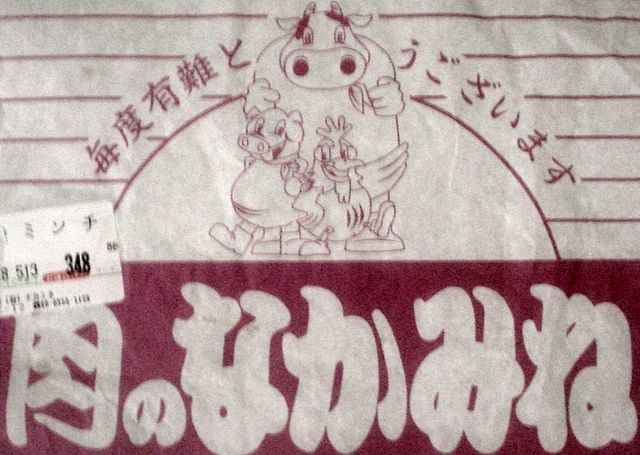
I got a kick out of this. The paper our meat is wrapped in has a cow, a pig and a chicken on the front. They seem to be ecstatic about giving us their tender juicy sides for us to enjoy. I'm not sure if this is how they are before they know they are going to be slaughtered or after, but it is good to know my meat is happy!
Tuesday, May 31, 2005
Frustration
It was my assignment this morning to find some flyers advertising community Japanese learning courses that might be offered at community centres and the like in my neighbourhood. Aukje gave me two locations, pointed out where they would on the map, described where the were, and sent me on my way. I jumped on my bike with a little apprehension, since I did not know where I was going and don't have enough language yet to help things much. I zipped up the street toward the first location, a community learning centre. I got to the overhead expressway before I realized I'd gone much too far in my haste. I back tracked to the number 14 block and found the building I thought I was looking for. I was a little skeptical, it did look very communitycenterish but I wasn't sure. I parked and locked my bicycle and ventured in. I wandered around a little looking for a big flyer rack filled with brochures advertising this and that. All I could come up with was a pitiful little excuse holding about twenty flyers. The place smelled somewhat hospitalish as well. I snagged a couple potentials but didn't hold out much hope. This couldn't be the right place.
I decided to get to my next destination, the library. I found the NTT building right where Aukje said it would be, and turned the corner to look for the library. Where I expected the library to be I found a taxation building (the sign was in English). I looked a little further and found a building that looked like a potential. Again I parked and locked my bicycle and ventured in. Aukje had told me that the library was on the third floor and that I could take either the elevator or the stairs. I wandered around looking for a way up but I couldn't find either stairs or an elevator. Not to have been wandering around for nothing I stopped at the washroom which made me feel a little less frustrated. I found another pitiful rack of flyers on my way out, nothing potentially language like however. I left. I hopped on my bicycle and went round the other side of the building and, Eureka! I did indeed find the library. About time I thought. Yup. There were the stairs and an elevator. I parked and locked my bicycle and headed for the elevator. I entered and hit the button for three. Curiously the doors didn't close, so I hit the close door button. Then I didn't go anywhere. I tried the other third floor buttons (beside the button panel in the usual place there were button panels on each side of the elevator as well) and when nothing happened I repeatedly jabbed the buttons for a while. As I was jabbing I noticed a little sticky note on one of the buttons with some kanji written on it. Perhaps it had something to do with the elevator trouble. "Well no matter" sez I to myself, I shall take the stairs. I arrived at the second level only to find a chain barring my way. It now dawned upon me that perhaps the library was closed. Hmmm. I headed back down, to see a lady tossing a library book into the return book thingy at the bottom of the stairs, adding more support for my hypothesis. I hopped on my bike and headed home, feeling like a complete and utter failure. Such is coping with life in a foreign city.
I decided to get to my next destination, the library. I found the NTT building right where Aukje said it would be, and turned the corner to look for the library. Where I expected the library to be I found a taxation building (the sign was in English). I looked a little further and found a building that looked like a potential. Again I parked and locked my bicycle and ventured in. Aukje had told me that the library was on the third floor and that I could take either the elevator or the stairs. I wandered around looking for a way up but I couldn't find either stairs or an elevator. Not to have been wandering around for nothing I stopped at the washroom which made me feel a little less frustrated. I found another pitiful rack of flyers on my way out, nothing potentially language like however. I left. I hopped on my bicycle and went round the other side of the building and, Eureka! I did indeed find the library. About time I thought. Yup. There were the stairs and an elevator. I parked and locked my bicycle and headed for the elevator. I entered and hit the button for three. Curiously the doors didn't close, so I hit the close door button. Then I didn't go anywhere. I tried the other third floor buttons (beside the button panel in the usual place there were button panels on each side of the elevator as well) and when nothing happened I repeatedly jabbed the buttons for a while. As I was jabbing I noticed a little sticky note on one of the buttons with some kanji written on it. Perhaps it had something to do with the elevator trouble. "Well no matter" sez I to myself, I shall take the stairs. I arrived at the second level only to find a chain barring my way. It now dawned upon me that perhaps the library was closed. Hmmm. I headed back down, to see a lady tossing a library book into the return book thingy at the bottom of the stairs, adding more support for my hypothesis. I hopped on my bike and headed home, feeling like a complete and utter failure. Such is coping with life in a foreign city.
My new neice

Everyone...
May I introduce Hailey Elizabeth, born on 22 May to my brother Paul and his wife Cindy in Georgetown.
May God richly bless this new life.
Monday, May 30, 2005
You are entering the Twilight Zone...

Necoro.
From the manufacturer Omron, whom I have (up to this point in my life) only associated with PLC controls and it's related doodads. A cute little kitty cat. A fake cat that seems too real to be cute, disconcerting would be a more accurate term. Quicktime movies of this furry little critter. I think this would have made a good basis for a Twilight Zone episode.
Friday, May 27, 2005
Coffee Time

Today, I shall post my heaps of appreciation to Chiemi (a friend of Aukje’s who lives near Tokyo), for the coffee maker she got for us as a wedding gift. Here it is almost finished concocting that delectable brew known as kohi. Behind the camera Aukje and I are salivating as we drink in the aroma, nay the fragrance of Blendy, (the locally available and most reasonably priced java). As you can see we are thoroughly enjoying this gift.
Thursday, May 26, 2005
Today's Service
The centre of God’s will is our only safety. – Betsie ten Boom
The past couple of weeks at our meeting of the Budonoki Seru Chiyaachi (Grapevine Cell Church) the sermon has been related to World War II. The pastor we have been listening to is Hirano Sensei (Pastor Hirano) of Horizon Chapel in Tokyo.
The chapel creates a DVD of every service and sends it to all their subscribers. We use these DVDs as a way of conveying a message from a Japanese pastor at our Thursday meetings. It has been very educational to be a party to hearing a Japanese pastor speak on this topic, getting a glimpse of how this topic resonates with the Japanese. His message of taking responsibility for one’s actions and then seeking forgiveness is very biblically centered, and I think relevant though now fading with the passing of the generation who was directly affected by the war .
Since I am a first generation Canadian of Dutch decent, I know well this feeling of hurt related to WWII, from the Dutch community I grew up in. I’ve heard many a tale and many a heartfelt recollection of the war from a large group of people who emigrated immediately after the war. Experiences which were related to me from my family, has given me a much closer tie to WWII than the average North American.
I think that most North Americans were largely insulated from WWII since most of the war (apart from Pearl Harbour) was fought in other parts of the world. The North American pain is tied largely to those who sent their sons, brothers and fathers to war.
In the pocket of Canadian-Dutch people where I grew up there was still some animosity against the German people, and only by the grace of God and Christ centered forgiveness can such gaping wounds be healed. I appreciate this work of Tokyo Horizon Chapel, and hope they continue working out God’s sovereign plan of redemption.
Seek the centre of God's will.
The past couple of weeks at our meeting of the Budonoki Seru Chiyaachi (Grapevine Cell Church) the sermon has been related to World War II. The pastor we have been listening to is Hirano Sensei (Pastor Hirano) of Horizon Chapel in Tokyo.
The chapel creates a DVD of every service and sends it to all their subscribers. We use these DVDs as a way of conveying a message from a Japanese pastor at our Thursday meetings. It has been very educational to be a party to hearing a Japanese pastor speak on this topic, getting a glimpse of how this topic resonates with the Japanese. His message of taking responsibility for one’s actions and then seeking forgiveness is very biblically centered, and I think relevant though now fading with the passing of the generation who was directly affected by the war .
Since I am a first generation Canadian of Dutch decent, I know well this feeling of hurt related to WWII, from the Dutch community I grew up in. I’ve heard many a tale and many a heartfelt recollection of the war from a large group of people who emigrated immediately after the war. Experiences which were related to me from my family, has given me a much closer tie to WWII than the average North American.
I think that most North Americans were largely insulated from WWII since most of the war (apart from Pearl Harbour) was fought in other parts of the world. The North American pain is tied largely to those who sent their sons, brothers and fathers to war.
In the pocket of Canadian-Dutch people where I grew up there was still some animosity against the German people, and only by the grace of God and Christ centered forgiveness can such gaping wounds be healed. I appreciate this work of Tokyo Horizon Chapel, and hope they continue working out God’s sovereign plan of redemption.
Seek the centre of God's will.
Wednesday, May 25, 2005
Rapid Transit

Last evening in my travels I was near Tennoji, which is a major hub for train traffic. As I was coming to this bridge, I thought to myself very cool, two levels of trains and under that a road. To my left there is also the expressway which goes over top of the whole kitandkabudle. While I was enjoying the urbaness of it all and snapping a photo, a train sped by adding (for me) to the ambiance. I briefly toyed with the idea of standing there until two trains (upper and lower)came by at the same time with maybe a car and a bike underneath. But after mentally going through some probability calculations, I realized I might be there for quite some time (even in Japan).
Monday, May 23, 2005
A Commotion

I heard some odd noises. I poked my head out of my apartment window to see what the commotion was. I saw school kids, millions of 'em. Well that might be a slight exaggeration. There were at least 49. And they kept coming, stretching from around the corner of our apartment building, along the street and around the next corner.
My memory went with nostalgia. Thinking about being a school kid and school trips of yore. Although they involved long arduous busrides to and from our destination. Yikes, I'm not quite so nostalgic any more.
Saturday, May 21, 2005
A Jaunt
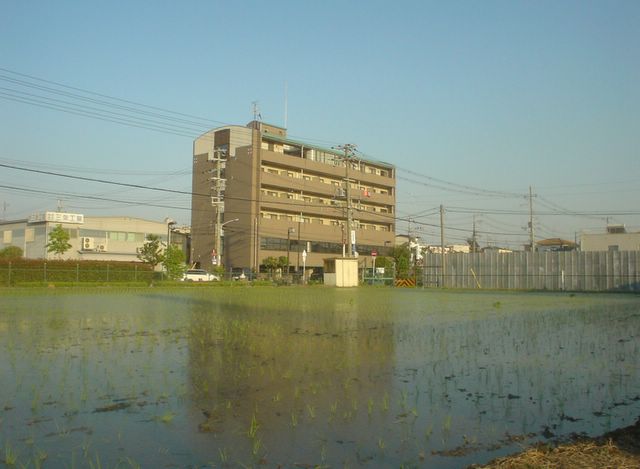
I took out my newly put together bicycle, and headed down 163. (163 is one of the major streets that comes past Sekime.) I didn't know where I was going, but I knew I would find something interesting. I found this rice paddy, squeezed between apartment buildings and automotive shops. The dealership a few doors down had a couple of Lambourgini's for sale. It was a quite a contrast.
Friday, May 20, 2005
Diver Down

As a person gets used to a new culture there are always many surprising and interesting moments. Something that was completely unexpected for me, Osaka has more dive shops than Tobermory does. I guess I shouldn't have been so taken aback since Japan is surrounded by ocean.
Wednesday, May 18, 2005
A cultural moment.
When a North American person points to themselves, they point to their chest, but when a Japanese person points to themselves they point to their nose.
I'm not used to it yet.
I get distracted thinking about the cultural differences when I should be concentrating on what the person is saying, especially with my nonexistent level of Japanese.
Communication is so much more than language.
I'm not used to it yet.
I get distracted thinking about the cultural differences when I should be concentrating on what the person is saying, especially with my nonexistent level of Japanese.
Communication is so much more than language.
Tuesday, May 17, 2005
Green Tea

This my friends, is a Green Tea Chocolate Chip Cookie. I wasn't sure what to expect. Green Tea flavoured things are quite popular here. Particularly Green Tea flavoured ice cream. (Which is quite good as well). The green tea with the chocolate makes for an interesting combination. Food combinations are quite a science in Japan and a lot of R & D seems to go into it.
Monday, May 16, 2005
Fun with learning the lingo.
Lately I have taken to telling people here in Japan (with a furrowed brow and a very serious look on my face):
Watashiwa nihonjindewa arimassen.
I am not Japanese.
It usually gets a quiet response for a moment as the person tries to figure what I really mean, and then when I smile, a good laugh.
Watashiwa nihonjindewa arimassen.
I am not Japanese.
It usually gets a quiet response for a moment as the person tries to figure what I really mean, and then when I smile, a good laugh.
Sunday, May 15, 2005
The Unknown Continued...
Yesterday I met my little friend in the elevator again. I was arriving home, and as the elevator got to my floor, she was getting on. She politely bowed to me (which I thought to be extremely cute) but seemed a little nervous as she looked at me. I said in my very best Japanese "Konichiwa" (Good Afternoon) to which she replied with a smile, "Konichiwa".
I was chuffed.
I was chuffed.
Saturday, May 14, 2005
Hey Heather!

This post is dedicated to a friend of mine who works at Jergens Canada. Biore in Japan! I snapped this picture as I was leaving the 24 hour grocery store on the other side of the tracks from my apartment. I chuckled as I checked out the Jergens website. It seems they are on a campaign to make people's skin darker no matter the season! Now I am no advertising, branding or product expert, but I think I'll offer a little free marketing advice for the fine folks at Jergens. Don't export the campaign to Japan! The societal ideal here is for woman to be as pale as possible. Any exposure to the sun is terrible, and many precautions are taken to ward off the sunshine when women are out and about. However as I said I am no expert and perhaps you can change thousands of years of cultural and historical trends and make everyone feel they need your product. You could corner the market if you are successful, and I for one would certainly be interested in watching your attempts.
Thursday, May 12, 2005
After

I mailed my bike to myself. It is over ten years old and not an expensive bike or anything (note to any thieves out there, It is not worth stealing!) but it is like a good pillow. I had to deconstruct it slightly to fit it into a box that was mailable. I added some books and computer equipment and I managed to slip it in the mail at 29.5 Kg. I was cutting it close as the limit for Canada Post is 30 Kg. The box was slightly too long so I had to pay a surcharge. I'm sure you've heard of the "slow boat to China", well I sent it on the slow boat to Japan. As it turned out, I beat my bike to Japan by only several days. The six weeks quoted actually turned out to four and a half. Snags: Pumps in Japan are made for Japanese valves. Locks and lights are mandatory and you might be pulled over if you don't have them. A kickstand is a good idea, and the one I bought was too short. All situations are rectified, but I probably will need to get some fenders as it rains quite often here.

Wednesday, May 11, 2005
This wisdom has recently been imparted to me.
The average time it takes for a Japanese person to go from thinking about Christianity and thinking about becoming a Christian to actually making some sort of commitment is about eight years.
If the person has been exposed to Christian education in some fashion (ie Catholic School) or has otherwise had some form of alternate exposure to a Christian worldview in the process of their growing up, that time can be decreased to a period of about three years.
It may be the radical nature of the Christian world view that causes problems when compared to the options that are generally presented in the process of growing up.
If the person has been exposed to Christian education in some fashion (ie Catholic School) or has otherwise had some form of alternate exposure to a Christian worldview in the process of their growing up, that time can be decreased to a period of about three years.
It may be the radical nature of the Christian world view that causes problems when compared to the options that are generally presented in the process of growing up.
Tuesday, May 10, 2005
A walk by the shore.
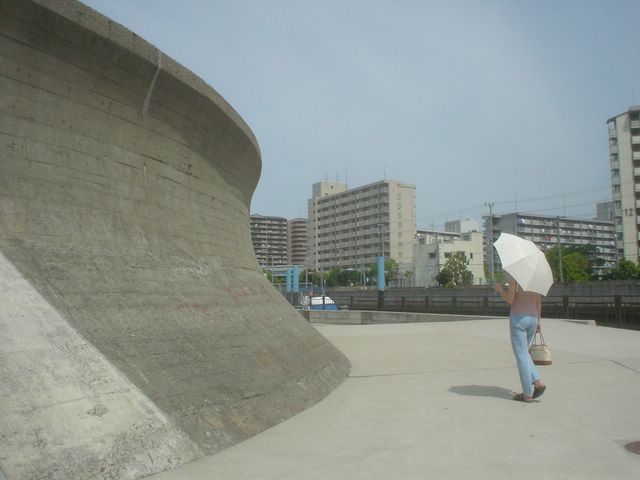
Late last week Aukje and I went to see one of her previous Alpha students in Nishinomiya. Nishinomiya is a city between Osaka and Kobe. After the visit we took a stroll down to see the ocean (since we were in the neighbourhood). What we saw were mostly man made land areas built in the bay on which Kobe and Osaka were established.
In light of the recent devastating tsunami, I was impressed by the preparation of the people in Nishinomiya. This sea wall was constructed to turn quite a large wave over. In other areas there were thick steel doors/gates that are normally open to allow traffic flow but are ready to be closed just in case. These preparations are not new, but I don't think they would be robust enough to stem a tsunami the size of the one which recently took place.
Friday, May 06, 2005
Our washroom is soo small...
You have to be careful you don’t hit your head on the door when you sit down.
Watashi no atama ga toire no doaa ni butskarimashita. Itai! (Itakattadesu) (past tense of Itai.)
I hit my head on the washroom door. Ouch!
(Based on a true story) (again)
Woo. That smarts.
I wondered how I would take to saying Itai instead of ouch as I try to become bilingual. I don't know if I'll have enough wits about me when I hurt myself to translate to Itai! before Yow! comes out.
Hmmm, I may have to practice.
Watashi no atama ga toire no doaa ni butskarimashita. Itai! (Itakattadesu) (past tense of Itai.)
I hit my head on the washroom door. Ouch!
(Based on a true story) (again)
Woo. That smarts.
I wondered how I would take to saying Itai instead of ouch as I try to become bilingual. I don't know if I'll have enough wits about me when I hurt myself to translate to Itai! before Yow! comes out.
Hmmm, I may have to practice.
Wednesday, May 04, 2005
It's a Good Thing Aukje was Home
Watashi wa kagi o wasuremashita.
I forgot my key.
(Based on a true story)
I forgot my key.
(Based on a true story)
Monday, May 02, 2005
Old Fridge New Fridge Small Fridge Green Fridge

Well I am no Dr. Seuss that is for sure. But we do indeed have a new fridge. It is three times the size of our old fridge and we no longer have vegetables and fruit and diet coke lying around on shelves and/or the floor. We successfully bought our fridge from a smallish appliance store in Den Den Town and felt we got a very good deal. Our fridge is a Sharp and the other two fridges we were looking at were made by Toshiba and Sanyo. All are major brand names in North America, but none are associated with fridges. In Japan these companies are very diverse, and many major companies make a large variety of different types of products. Our fridge has an upper refrigeration compartment with a door that can be opened from either side, a freezer drawer under that and at the bottom a vegetable drawer. Let me reiterate, Cool! A door that opens from both sides and drawers!
Saturday, April 30, 2005
A Japanese Barbeque

It was my distinct adventure to be a part of a Japanese Barbeque yesterday. Yesterday was Greenery Day the first day of Golden Week, a string of four holidays almost consecutively. The church that Aukje has been attending most Sundays while she has been living in Osaka, had a church barbeque at the hanabakutsurumiryokuchi (a big park a 25 min walk from our apt.). The park has barbequing areas and the church had secured one of these. The affair lasted for about 5 hours and we were eating most of the time. Food comes in small quantities but flows continuously. I sampled a large variety of different foods many of which I am not used to. I stayed away from the grilled squid, but sampled the cow intestine, the bamboo chutes, and the dried squid. I thoroughly enjoyed the beef and the sausages. I also enjoyed a tin of Kirin and got a taste of some really enjoyable rice wine.
Communication was not easy when I was engaged on my own but we managed with my few Japanese words and their few English words and some gestures as well. For more in depth conversation my wife did some interpreting for me. I was exposed to many interesting cultural moments. It was an enjoyable time but also very tiring.
Wednesday, April 27, 2005
Den Den Town
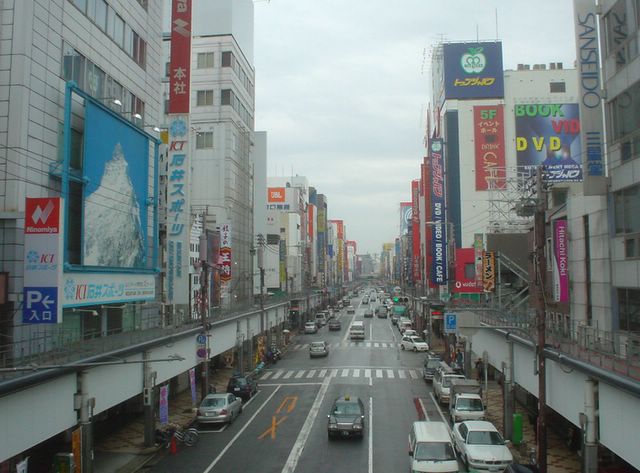
We are shopping for a fridge. Shopping for a fridge in a foreign country is different from shopping for a fridge in your native country. It can be more difficult because you are attacking the problem without much knowledge. First of all we didn't know where to go. We happened across a small appliance store in our neighborhood and had a boo, checked the prices and sizes. (There are scads of different sizes of fridges here). Later we realized there were fridges at the Yodabashi so we checked prices (which were cheaper than in the neighborhood) and selection was much more varied. We found two which would be suitable, but decided not to buy just yet. As we were headed to Yodabashi we met and talked to Noelle a Japanese friend (who speaks English) and she suggested Den Den Town was the place to go. I went on a scouting mission and discovered a place of nothing but electronics and related products. Spectacular to a technophobe such as myself. I discovered a very large variety and even better prices in an area that spans city blocks. Jackpot!
Tuesday, April 26, 2005
A time of Grief
In my new city, we had a tragedy yesterday. A train crash. The worst train disaster in Japan since 1963. The Japanese railway system, which is very extensive and on which a vast number of people rely for transportation, is considered one of the safest in the world. I fear for the driver. Traditional Japanese culture will demand honour. A situation of this magnitude will demand his death to satisfy that honour. I hope God's grace will prevail.
I lament this chaos.
I lament this chaos.
Saturday, April 23, 2005
Pocari Sweat

This one is for all you William Gibson fans (like me). On first glance to North Americans it looks like something sweet, but no it does actually say sweat. I wonder if that is supposed to taste good? My wife, once, when she was in a hurry and very thirsty was running by a drink machine, (which there are a lot of in Japan). Quickly she popped in her change and thought, hmmm, something sweet might be nice. Almost needless to say but not quite since it adds to the story, she reread the can after the first sip. Kampai!
Friday, April 22, 2005
A Quote
We are but two dimensional manifestations in a two dimensional world. Oh how I long for that day of glory when we will inhabit and engage all seven dimensions.
Wednesday, April 20, 2005
A Brush with the Unknown
I was on my way to the grocery store. I was chuffed to see the elevator already on my floor. As I hopped in the elevator I heard a door slam and then small feet as they scurried for the elevator. A little girl about six or seven quickly jumped into the car with me. Adults often keep their head down, polite but nervous about what to say to a foreigner. The little girl greeted me with interest and a smile. Konichiwa, I greeted her, and she responded with the same. She said to me, kono ikura desuka? My first clue, the tone of voice. Aha a question! Hmm, a simple question. I searched my memory banks. What could she be asking? I made like Arnold Schwarzanegger in the Terminator, scrolling through all the data bank menus, searching searching… Wait a glimmer, I think she is asking me where I am from. Quickly, acting as if there was no unnatural pause, (even though I bought myself some time with an um) I responded Kanada, with a big happy smile. She seemed a little confused; perhaps she doesn’t know what country that is. We arrived at the lobby where her bicycle was waiting, she had just forgotten her keys. I held the door open for her so she could easily get her bike out, and after we were done, I got a big smile and an arigatoo. (Thankyou). I waved good bye and mumbled something back. I think I may have made a friend. I was certainly a very happy person today.
Update:
Upon further reflection and discussion with my sensei who actually speaks Japanese, Okuni would be the word for country, so she wasn't asking me that, hence the confusion on her face. Further, what I have written doesn't make sense. Hmmm. My first conversation didn't go well.
Update:
Upon further reflection and discussion with my sensei who actually speaks Japanese, Okuni would be the word for country, so she wasn't asking me that, hence the confusion on her face. Further, what I have written doesn't make sense. Hmmm. My first conversation didn't go well.
Friday, April 15, 2005
Feet Dry
We touched down at Kanasi airport at 3:17pm local time, and arrived at our apartment at about 5:30pm. Traffic on the train and subaway was fairly light for this time of day. That was a Godsend since with three large and two small bags it was much easier to make our journey home.
Wednesday, March 30, 2005
Old Stuff for Posterity
This is an old assignment I did when I was at ICS. Posted for posterity.
The assignment was to answer the question Why do You get up in the morning, point out three major influences and two standouts in Steven Garber's book The Fabric of Faithfulness.
Why Do I Get Up In the Morning?
My alarm goes off and I groan. I don't want to get up. I am not a morning person. For some strange reason God did not wire me that way. So, as I head out the door to work at 7:30 am plus or minus a half-hour, (usually plus), I am not pondering why I got up, only that my sense of duty, my Calvinist work ethic demands it. As the morning starts to mature and I have completed all the first things at work, I am able to think about such things. If it is a busy time at
work one would find me designing machines, a gift I have combining the creative juices, and the technical aptitude
God has given me. This leads me to one of the primary reasons I get up most mornings. One of my deep desires is to
use my God given talents to benefit others and to do this to the glory of God.
Garber talks about John John (p 112), who says, "Living a life of glory to God is living a life of integrity, a life that
speaks louder than words." How can I measure up to that? I endeavour to live a life of integrity, to measure up to all that God would ask of me, but I always fall down and it is only by the Grace of God that I can get back get up.
I think living a life of glory to God is using one's gifts and talents in meaningful, useful ways.
I get up in the morning to create things. Whether it is designing machines at work, creating something memorable on the soccer pitch, sketching, building something in my woodshop, carving first tracks on a snow covered mountain or
simply using my imagination, I like to make things.
Two other reasons I get up, to interact with God's good though currently sin wrinkled creation, and to teach the
Heidelberg Catechism to my small band of grade 12 students.
It seems that to use one's spiritual gifts is to glorify God and find satisfaction in doing so, and that is what makes it
worth while getting up in the morning.
2. Three major influences:
All the people Garber interviewed for his book, they could 'only connect' faith and life. All had learned a worldview
that would stand the tests of the world. All had Convictions. All had found someone to teach and live that
worldview, someone that could provide an example. All had Character. All had developed ITiendships with like¬
minded people whose regular life was rooted in that same worldview. All had Community. It is well worth noting as
Garber says, "There were no exceptions" (p 111).
I have come by my own worldview, a worldview that has indeed stood the test of time, by the Grace of God. All the
years I spent growing up in the broader community of the Christian Reformed Church, I was gaining worldview by
osmosis, and it wasn't until someone finally articulated that worldview to me that I said to myself, 'Eureka!' this is
what I always knew but didn't know. As Dan Heimbach says (Garber p 122) " I couldn't turn my back on what I
knew to be true."
Who is my teacher? Well I can't pick out a specific teacher that exemplified this worldview. Perhaps I am an
exception, or perhaps everything is about to come crashing down. Maybe I could cheat a little and say that my father
was my mentor. He lived this worldview though he never articulated it. He gave me a living example, an example I
watched... and followed.
3. Two stand outs:
Truth. For all of Garber's interviewees belief in truth stands out. My own belief in truth is basic to my being. It
stems ITom belief in God, in belief in right and wrong, in believing that there are transcendent truths and higher
moral values. If the momentous leanings of our culture determine truth, well then there really is no truth at all.
Coherence. For all of Garber's interviewees a desire for coherence stands out. This, I think can be partnered with
faith. It is important for our God given logically thinking minds to find coherence in our world and how we interact
with it. I like the fact that I can make decisions based on the coherence of my worldview. But here I have questions.
Is it necessary to be coherent? Ifwe could logically and coherently explain Christianity would we need faith? And if
we didn't need faith, what would we have?
The assignment was to answer the question Why do You get up in the morning, point out three major influences and two standouts in Steven Garber's book The Fabric of Faithfulness.
Why Do I Get Up In the Morning?
My alarm goes off and I groan. I don't want to get up. I am not a morning person. For some strange reason God did not wire me that way. So, as I head out the door to work at 7:30 am plus or minus a half-hour, (usually plus), I am not pondering why I got up, only that my sense of duty, my Calvinist work ethic demands it. As the morning starts to mature and I have completed all the first things at work, I am able to think about such things. If it is a busy time at
work one would find me designing machines, a gift I have combining the creative juices, and the technical aptitude
God has given me. This leads me to one of the primary reasons I get up most mornings. One of my deep desires is to
use my God given talents to benefit others and to do this to the glory of God.
Garber talks about John John (p 112), who says, "Living a life of glory to God is living a life of integrity, a life that
speaks louder than words." How can I measure up to that? I endeavour to live a life of integrity, to measure up to all that God would ask of me, but I always fall down and it is only by the Grace of God that I can get back get up.
I think living a life of glory to God is using one's gifts and talents in meaningful, useful ways.
I get up in the morning to create things. Whether it is designing machines at work, creating something memorable on the soccer pitch, sketching, building something in my woodshop, carving first tracks on a snow covered mountain or
simply using my imagination, I like to make things.
Two other reasons I get up, to interact with God's good though currently sin wrinkled creation, and to teach the
Heidelberg Catechism to my small band of grade 12 students.
It seems that to use one's spiritual gifts is to glorify God and find satisfaction in doing so, and that is what makes it
worth while getting up in the morning.
2. Three major influences:
All the people Garber interviewed for his book, they could 'only connect' faith and life. All had learned a worldview
that would stand the tests of the world. All had Convictions. All had found someone to teach and live that
worldview, someone that could provide an example. All had Character. All had developed ITiendships with like¬
minded people whose regular life was rooted in that same worldview. All had Community. It is well worth noting as
Garber says, "There were no exceptions" (p 111).
I have come by my own worldview, a worldview that has indeed stood the test of time, by the Grace of God. All the
years I spent growing up in the broader community of the Christian Reformed Church, I was gaining worldview by
osmosis, and it wasn't until someone finally articulated that worldview to me that I said to myself, 'Eureka!' this is
what I always knew but didn't know. As Dan Heimbach says (Garber p 122) " I couldn't turn my back on what I
knew to be true."
Who is my teacher? Well I can't pick out a specific teacher that exemplified this worldview. Perhaps I am an
exception, or perhaps everything is about to come crashing down. Maybe I could cheat a little and say that my father
was my mentor. He lived this worldview though he never articulated it. He gave me a living example, an example I
watched... and followed.
3. Two stand outs:
Truth. For all of Garber's interviewees belief in truth stands out. My own belief in truth is basic to my being. It
stems ITom belief in God, in belief in right and wrong, in believing that there are transcendent truths and higher
moral values. If the momentous leanings of our culture determine truth, well then there really is no truth at all.
Coherence. For all of Garber's interviewees a desire for coherence stands out. This, I think can be partnered with
faith. It is important for our God given logically thinking minds to find coherence in our world and how we interact
with it. I like the fact that I can make decisions based on the coherence of my worldview. But here I have questions.
Is it necessary to be coherent? Ifwe could logically and coherently explain Christianity would we need faith? And if
we didn't need faith, what would we have?
Monday, March 28, 2005
GDCS
I am an alumni of Georgetown District Christian School, and recently I was asked to write a short blurb for the school paper, the following is what spilled out.
As I was thinking about my sojourn in GDCS, the toil, the complex assignments, the arduous homework inflicted upon me by my teachers, I recalled my very first day of school. I remember someone directing me to my new desk in Grade 1. It was well before class was going to start, and everyone else was outside having fun. I recall the sun shining and being jealous of those kids, laughing and yelling, you know the way all playgrounds sound from a short distance. Miss Charlton said I could go outside but I was worried I wouldn’t be able to find my way back to my desk let alone the classroom. It seems I was not much of an explorer.
It turns out that a little perspective changes things and all that labour wasn’t really so difficult, actually I look back on my time at GDCS with warmth in my heart.
I went on to high school at Toronto District Christian High School and then studied engineering at Sheridan College for three years. My career started slowly but after working for several different companies in the engineering field, gaining experience in design. I settled into a position with my current company PROMAT Engineering Sales Inc. where I design machinery for the material handling industry. People always wonder what that means, and I explain that we are experts in movement of flowing materials such as lime, talc, or chocolate chips. I enjoy combining my God-given creativity and penchant for machines, as I seek to glorify my creator with what I do.
I am at one of those life’s crossroads however, in the midst of not only a career change, but also a matrimonial change. I am soon to be wed to the most beautiful woman in the world, (I may be biased) on April 2nd. I have also recently been appointed as a missionary to Japan and I am currently in the midst of raising support and getting ready to move to Osaka.
Japan promises to be a very challenging place to work, communication being one of the biggest challenges. I will be learning Japanese but even with the language in my back pocket, communicating biblical concepts such as sin or God’s love and grace remain a difficulty. I am looking forward to the challenge, but at the same time feel apprehensive. I think I’ll go sit at my desk for a little while.
Will Dykstra – Class of 1980
As I was thinking about my sojourn in GDCS, the toil, the complex assignments, the arduous homework inflicted upon me by my teachers, I recalled my very first day of school. I remember someone directing me to my new desk in Grade 1. It was well before class was going to start, and everyone else was outside having fun. I recall the sun shining and being jealous of those kids, laughing and yelling, you know the way all playgrounds sound from a short distance. Miss Charlton said I could go outside but I was worried I wouldn’t be able to find my way back to my desk let alone the classroom. It seems I was not much of an explorer.
It turns out that a little perspective changes things and all that labour wasn’t really so difficult, actually I look back on my time at GDCS with warmth in my heart.
I went on to high school at Toronto District Christian High School and then studied engineering at Sheridan College for three years. My career started slowly but after working for several different companies in the engineering field, gaining experience in design. I settled into a position with my current company PROMAT Engineering Sales Inc. where I design machinery for the material handling industry. People always wonder what that means, and I explain that we are experts in movement of flowing materials such as lime, talc, or chocolate chips. I enjoy combining my God-given creativity and penchant for machines, as I seek to glorify my creator with what I do.
I am at one of those life’s crossroads however, in the midst of not only a career change, but also a matrimonial change. I am soon to be wed to the most beautiful woman in the world, (I may be biased) on April 2nd. I have also recently been appointed as a missionary to Japan and I am currently in the midst of raising support and getting ready to move to Osaka.
Japan promises to be a very challenging place to work, communication being one of the biggest challenges. I will be learning Japanese but even with the language in my back pocket, communicating biblical concepts such as sin or God’s love and grace remain a difficulty. I am looking forward to the challenge, but at the same time feel apprehensive. I think I’ll go sit at my desk for a little while.
Will Dykstra – Class of 1980
Wednesday, March 02, 2005
Thankyou very much
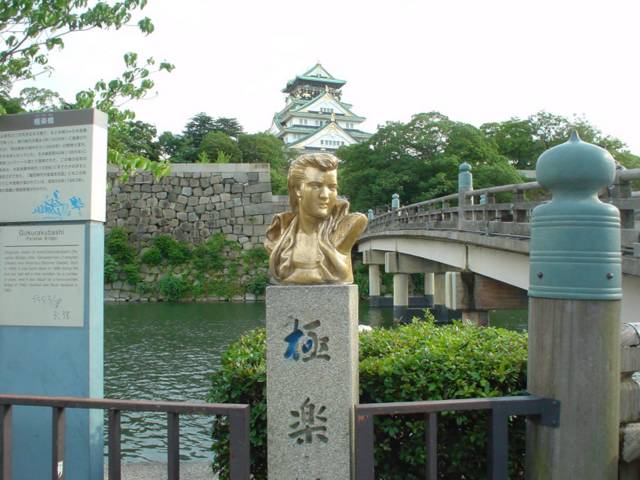
While I was in Japan my fiancee's sister's husband's brother sent over a bust of Elvis. He wanted us to take pictures of Elvis doing Japanese things. Aukje took him to see cherry blossoms at the park. I wanted to tie him to the train tracks, but Aukje didn't think we could get away with it. We had Elvis at an Alpha, and we also took him to Osaka Castle, which as you can see is about the same size as Elvis head. Elvis was quite heavy, I would say about 20lbs and had to be put in my big backpack for transport, as he didn't fit in a day pack. Aukje's sister's husband's brother has several Elvis's on the go, and Elvis has already been to many places.
Monday, February 07, 2005
A cold one to tide you over

No matter where you go it seems the beer companies have a big advertising budget.
I humbly bow and ask your forgiveness
(How very Japanese of me)
My apologies for the lack of posts in recent times. My time has been stretched to its limits lately and it doesn't look to be letting up anytime soon. Between working extra hours, working to prepare myself to go overseas and working at arranging a wedding, time is stretched very tautly, and if one seam lets go my life would develop some big rips and rends. I envision more regular updates after I am settled in Japan, (latter half of April). In the meantime I would like to warn my vast readership that I am planning an odd update here and there, but nothing deeper and more pithy than a can of beer.
My apologies for the lack of posts in recent times. My time has been stretched to its limits lately and it doesn't look to be letting up anytime soon. Between working extra hours, working to prepare myself to go overseas and working at arranging a wedding, time is stretched very tautly, and if one seam lets go my life would develop some big rips and rends. I envision more regular updates after I am settled in Japan, (latter half of April). In the meantime I would like to warn my vast readership that I am planning an odd update here and there, but nothing deeper and more pithy than a can of beer.
Monday, January 17, 2005
An Osaka Steet Scene

It has come to my attention that there has been an oversight. The Sekime photolog has not had a photo for quite some time. In order to rectify the problem I have chosen a photograph for you to enjoy. It does not have much significance other than the fact that it actually is a photograph. It was taken on my way from the YWCA where I went to language school to Umeda where I could catch the train or the subway.
Friday, January 14, 2005
Wednesday, January 05, 2005
Retro-blogging
As I've posted before, I attended the Worldview Foundations course at the ICS a couple year's ago.
One of my assignments was to write a short scenario, on what the world would look like in fifty years, if the world developed as a culturally hardened, high conflict world. It had to written from the point of view of my home church.
I thoroughly enjoyed writing it and like the story myself. I thought I'd republish it in this forum.
The Georgetown CRC - 2052 in a culturally hardened, high conflict world.
Juanita looked up at the moon obscured by a cloud of pollution. Remembering the moon of her childhood, a pristine white orb, she thought it was a shame it had been sold to Microsoft-Hyundai-ING. The company had moved their entire global operations to the moon including employees and they had brought in as much commercial and cultural support as they deemed necessary. She thought that in spite of the pollution it would be a nice place to live, far removed from the trouble here on earth. Maybe she could live on the far side of the moon with the Mennonites. It would be nice to meet the people who send the automated relief re-entry drones. She was thankful for the food and clothing that they provided.
GCRC with it's long tradition of local and overseas justice work had tried
to stem the tide of Muslim domination by sending some people to the Islamic
Republic, a large Muslim state encompassing most of the northern part of the African continent. The people had been forced into the south of Africa along with most other Christians who had been unable to exist with in the Shari'a Law harshly enforced throughout the state. The Islamic Republic had built up their military and political power. One thing the Muslims never seemed to be short of was funds.
They had however been desperately short of food. At a time when it was difficult to stop them, they had sent well-equipped armies and farmers to Western Canada and Ontario looking for fertile land and fresh water supplies. Well-guarded military farms were efficiently set up and shortly thereafter the food supply line to Northern Africa was instituted. The Canadian army had fought with their legendary valiance but could not compete with the shear numbers of Muslims willing to die for their cause. Once the area had been secured, Muslims from all around North America as well as from Africa had gravitated to the area, setting up commercial support and populating the area, living like Kings from the wealth generated off the land.
But that was 15 long years ago. Since the fall of the Muslim Empire the country was no longer the super power it once was, and had degenerated to civil uprisings and quarrelling amongst Muslim factions. At the same time the dictator of the day had taken to sending "Jihad cells" to what they determined to be strategic pressure points around the globe.
She turned her attention back to the present situation. There were rumours of another raid perhaps this time by one of the infamous Jihad cells. Since the fall of the Muslim Empire the people who had been forced underground had begun to resist with better cohesion in this area of Muslim control. She was an advance scout and had to stay all but invisible while uploading observed troop movements to the local server.
She turned her thoughts back to home. Most communities had gone into hiding in order to survive. The Georgetown CRC had literally gone underground and currently most of its congregation made their home in one of the newly opened but now disused silver mines in the area. There was still Silver here but the fighting had made mining superfluous, and the mines were very easy to defend. Working in the resistance wasn't a nine to five job. She hoped she would make it to the afternoon service tomorrow. It would be good to see people again.
One of my assignments was to write a short scenario, on what the world would look like in fifty years, if the world developed as a culturally hardened, high conflict world. It had to written from the point of view of my home church.
I thoroughly enjoyed writing it and like the story myself. I thought I'd republish it in this forum.
The Georgetown CRC - 2052 in a culturally hardened, high conflict world.
Juanita looked up at the moon obscured by a cloud of pollution. Remembering the moon of her childhood, a pristine white orb, she thought it was a shame it had been sold to Microsoft-Hyundai-ING. The company had moved their entire global operations to the moon including employees and they had brought in as much commercial and cultural support as they deemed necessary. She thought that in spite of the pollution it would be a nice place to live, far removed from the trouble here on earth. Maybe she could live on the far side of the moon with the Mennonites. It would be nice to meet the people who send the automated relief re-entry drones. She was thankful for the food and clothing that they provided.
GCRC with it's long tradition of local and overseas justice work had tried
to stem the tide of Muslim domination by sending some people to the Islamic
Republic, a large Muslim state encompassing most of the northern part of the African continent. The people had been forced into the south of Africa along with most other Christians who had been unable to exist with in the Shari'a Law harshly enforced throughout the state. The Islamic Republic had built up their military and political power. One thing the Muslims never seemed to be short of was funds.
They had however been desperately short of food. At a time when it was difficult to stop them, they had sent well-equipped armies and farmers to Western Canada and Ontario looking for fertile land and fresh water supplies. Well-guarded military farms were efficiently set up and shortly thereafter the food supply line to Northern Africa was instituted. The Canadian army had fought with their legendary valiance but could not compete with the shear numbers of Muslims willing to die for their cause. Once the area had been secured, Muslims from all around North America as well as from Africa had gravitated to the area, setting up commercial support and populating the area, living like Kings from the wealth generated off the land.
But that was 15 long years ago. Since the fall of the Muslim Empire the country was no longer the super power it once was, and had degenerated to civil uprisings and quarrelling amongst Muslim factions. At the same time the dictator of the day had taken to sending "Jihad cells" to what they determined to be strategic pressure points around the globe.
She turned her attention back to the present situation. There were rumours of another raid perhaps this time by one of the infamous Jihad cells. Since the fall of the Muslim Empire the people who had been forced underground had begun to resist with better cohesion in this area of Muslim control. She was an advance scout and had to stay all but invisible while uploading observed troop movements to the local server.
She turned her thoughts back to home. Most communities had gone into hiding in order to survive. The Georgetown CRC had literally gone underground and currently most of its congregation made their home in one of the newly opened but now disused silver mines in the area. There was still Silver here but the fighting had made mining superfluous, and the mines were very easy to defend. Working in the resistance wasn't a nine to five job. She hoped she would make it to the afternoon service tomorrow. It would be good to see people again.
Saturday, January 01, 2005
It is difficult to type with one arm behind your back
I am being coerced, blackmailed as it were into writing this blog.
Through many years as a Mapleleafs fan, (since the 1977 playoffs when the Leafs beat the Islanders in 7) I have never seen a player quite like Mats Johan Sundin, his skill as a hockey player and his poise as the Leaf Captain are better than any that I've seen in a MapleLeaf uniform. So Kudos to you Mats, your Mom is calling you for some Campbell's soup and I'm calling you to get your derriere back on the ice for some good old fashioned barn burning hockey, just like the good ol' days.
There you go M.A
Through many years as a Mapleleafs fan, (since the 1977 playoffs when the Leafs beat the Islanders in 7) I have never seen a player quite like Mats Johan Sundin, his skill as a hockey player and his poise as the Leaf Captain are better than any that I've seen in a MapleLeaf uniform. So Kudos to you Mats, your Mom is calling you for some Campbell's soup and I'm calling you to get your derriere back on the ice for some good old fashioned barn burning hockey, just like the good ol' days.
There you go M.A
Wednesday, December 22, 2004
I am accepted
December 22, 2004
I received in the mail today my acceptance letter from MUPs.
Dear Will:
On behalf of the Board, staff, and missionaries of Mission to Unreached Peoples, I want to take this opportunity to officially welcome you to this ministry. Your application, references, interview, and psychological profiles have been carefully reviewed, and we have agreed to accept you as approved Mission to Unreached Peoples personnel.
You are now officially ready to begin preparations for your anticipated ministry to serve in Japan. Your preparation for ministry and transitioning your life in Japan will be a team joint effort between yourself and the guidance provided for you from your field leadership.
Will, we are standing with you, asking God through the power of the Holy Spirit to help you. Getting ready to leave to do the work God has prepared for you is an exciting time, full of anticipation and hope. But it can also be a difficult period, one full of hectic activity, doubts and testing.
I encourage you to begin go over the information contained in this packet. You will need to know the information it contains, and we need to be able to rely on the fact that you've read, studied, and are acting on it. We will be contacting you shortly to personalize your preparation and departure paperwork. It is imperative you know the steps necessary to take in order to reach your ultimate goal of service in the Great Commission in the wisest and best-prepared manner possible. Kathy Cranston will be your Candidate Manager, and will be your primary contact here in the office. Please especially take the Planning Steps suggestion and establish a prayer support group now and begin meeting with them weekly.
In the interval between now and the time you leave, it will be important for us to build good personal relationships with each other. Whenever you have a question or a need, please contact the office. You are joining a fellowship of like-minded brothers and sisters in Christ. We will be praying for you regularly and desire to stay in close touch with you.
You will need to begin to put together a mailing list and to think about sending out prayer letters for supporters and prayer partners now. It will be important to start to build this base of prayer and financial support and to keep your supporters informed about what's happening with your preparations.
It is important for you to know that, in accordance with IRS regulations, any funds sent on your behalf will be kept in an account in your name until you leave. Should you decide for any reason not to proceed with this ministry, the money received would then be channeled in consultation with you to other workers or projects. It normally cannot be returned.
Please also read through the Policy Manual carefully. We will contact you shortly to develop your personal budget and to finalize the Financial Agreement and Overseas Service Agreement.
I will be sending a letter, along with a copy of this letter, to your pastor telling him of your acceptance and suggesting ways in which we might work with your church and missions committee as they support you both with prayer, encouragement, and finances. We ask that you continue in discussion with your church about their involvement in your calling to this overseas ministry. This is a team effort, and we pray that your church will feel a part of this ministry in a vital way. We are available to help you with fundraising and with your relationship to your home church in any way that we can.
What an opportunity we have to be a part of the Great Commission and to work together to reach the unreached! Ahead of you is adventure, growth in faith, some setbacks and trials, but the Lord will be with you through it all. Remember, "Be strong in the Lord and in His mighty power. Put on the full armor of God so that you can take your stand against authorities, against the powers of darkness, and against spiritual forces of evil... therefore put on the full armor of God." We are praying that our Father will be helping you as you prepare spiritually, materially, and financially for this new adventure of faith.
"Praise be to God and thanks be to Him who always leads us in triumphal procession in Christ and through us spreads everywhere the fragrance of the knowledge of Him. For we are to God the aroma of Christ among those who are being saved and those who are perishing (II Corinthians 2:14-15)."
As always, should you ever have questions, concerns, or just want to discuss or pray about what is happening during the preparation process, don't hesitate to give me a call or to write. May our heavenly Father bless you with peace, joy, and power during this time as you rest in Him! (Philippians 4:19)
For the Kingdom,
Jeff Kwon
Director of Mobilization
I received in the mail today my acceptance letter from MUPs.
Dear Will:
On behalf of the Board, staff, and missionaries of Mission to Unreached Peoples, I want to take this opportunity to officially welcome you to this ministry. Your application, references, interview, and psychological profiles have been carefully reviewed, and we have agreed to accept you as approved Mission to Unreached Peoples personnel.
You are now officially ready to begin preparations for your anticipated ministry to serve in Japan. Your preparation for ministry and transitioning your life in Japan will be a team joint effort between yourself and the guidance provided for you from your field leadership.
Will, we are standing with you, asking God through the power of the Holy Spirit to help you. Getting ready to leave to do the work God has prepared for you is an exciting time, full of anticipation and hope. But it can also be a difficult period, one full of hectic activity, doubts and testing.
I encourage you to begin go over the information contained in this packet. You will need to know the information it contains, and we need to be able to rely on the fact that you've read, studied, and are acting on it. We will be contacting you shortly to personalize your preparation and departure paperwork. It is imperative you know the steps necessary to take in order to reach your ultimate goal of service in the Great Commission in the wisest and best-prepared manner possible. Kathy Cranston will be your Candidate Manager, and will be your primary contact here in the office. Please especially take the Planning Steps suggestion and establish a prayer support group now and begin meeting with them weekly.
In the interval between now and the time you leave, it will be important for us to build good personal relationships with each other. Whenever you have a question or a need, please contact the office. You are joining a fellowship of like-minded brothers and sisters in Christ. We will be praying for you regularly and desire to stay in close touch with you.
You will need to begin to put together a mailing list and to think about sending out prayer letters for supporters and prayer partners now. It will be important to start to build this base of prayer and financial support and to keep your supporters informed about what's happening with your preparations.
It is important for you to know that, in accordance with IRS regulations, any funds sent on your behalf will be kept in an account in your name until you leave. Should you decide for any reason not to proceed with this ministry, the money received would then be channeled in consultation with you to other workers or projects. It normally cannot be returned.
Please also read through the Policy Manual carefully. We will contact you shortly to develop your personal budget and to finalize the Financial Agreement and Overseas Service Agreement.
I will be sending a letter, along with a copy of this letter, to your pastor telling him of your acceptance and suggesting ways in which we might work with your church and missions committee as they support you both with prayer, encouragement, and finances. We ask that you continue in discussion with your church about their involvement in your calling to this overseas ministry. This is a team effort, and we pray that your church will feel a part of this ministry in a vital way. We are available to help you with fundraising and with your relationship to your home church in any way that we can.
What an opportunity we have to be a part of the Great Commission and to work together to reach the unreached! Ahead of you is adventure, growth in faith, some setbacks and trials, but the Lord will be with you through it all. Remember, "Be strong in the Lord and in His mighty power. Put on the full armor of God so that you can take your stand against authorities, against the powers of darkness, and against spiritual forces of evil... therefore put on the full armor of God." We are praying that our Father will be helping you as you prepare spiritually, materially, and financially for this new adventure of faith.
"Praise be to God and thanks be to Him who always leads us in triumphal procession in Christ and through us spreads everywhere the fragrance of the knowledge of Him. For we are to God the aroma of Christ among those who are being saved and those who are perishing (II Corinthians 2:14-15)."
As always, should you ever have questions, concerns, or just want to discuss or pray about what is happening during the preparation process, don't hesitate to give me a call or to write. May our heavenly Father bless you with peace, joy, and power during this time as you rest in Him! (Philippians 4:19)
For the Kingdom,
Jeff Kwon
Director of Mobilization
Monday, December 20, 2004
Pondering Authentic Glory to God
A few days ago I was pondering. I am posting this more for my own future benefit than for anything else, but of course anyone is welcome to peruse it.
Authentic praise is heartfelt. Too often in the NA church the praise comes more in the form of rhetoric. I think there may be too much rhetoric in our churches today. But that aside; when we praise God in North America, culture, language, and our worldview all come very much into play. Our praise is generally offered in context of these things. We generally praise God in our own language, we use words that are meaningful to us based on our experiences with life as well as with church.
How does one offer authentic praise in Japan? What is authentic praise from a Japanese standpoint?
I suppose they might offer up or elevate values they hold near and dear to their own hearts, core values and transfer them to God? For an example I think a core value in the Japanese culture is honour. Being honourable is especially important to the average Japanese person. So if God was infinitely and perfectly honourable, honour personified, that would constitute mighty high praise indeed, in the eyes and heart and soul and mind of a Japanese person. Or as a second example loyalty. Loyalty is another core value I think. So if God were worshipped as being omnipotently loyal, that too would be beautiful in the estimation of a Japanese person.
In our culture (North American, European) we have developed a large body of music and songs, poetry and stories, pop culture and high culture, over the years in praise to God.
But in Japan the cultural legacy is one built without God. Can we export our resources into a Japanese culture very different from that of western culture and expect that to be meaningful? How is authentic praise being generated in Japan? How can it be developed? How can we help in developing it?
Can there be Japanese music that is Christian? Can there be Japanese Literature that is praiseworthy? How can we develop art that is glorifying to God in Japan?
As a rookie missionary I look with not a little trepidation at the mountain that needs to be moved. I need to learn not to focus on the mountain but on the Mover. That is key to success, and to my well being.
Authentic praise is heartfelt. Too often in the NA church the praise comes more in the form of rhetoric. I think there may be too much rhetoric in our churches today. But that aside; when we praise God in North America, culture, language, and our worldview all come very much into play. Our praise is generally offered in context of these things. We generally praise God in our own language, we use words that are meaningful to us based on our experiences with life as well as with church.
How does one offer authentic praise in Japan? What is authentic praise from a Japanese standpoint?
I suppose they might offer up or elevate values they hold near and dear to their own hearts, core values and transfer them to God? For an example I think a core value in the Japanese culture is honour. Being honourable is especially important to the average Japanese person. So if God was infinitely and perfectly honourable, honour personified, that would constitute mighty high praise indeed, in the eyes and heart and soul and mind of a Japanese person. Or as a second example loyalty. Loyalty is another core value I think. So if God were worshipped as being omnipotently loyal, that too would be beautiful in the estimation of a Japanese person.
In our culture (North American, European) we have developed a large body of music and songs, poetry and stories, pop culture and high culture, over the years in praise to God.
But in Japan the cultural legacy is one built without God. Can we export our resources into a Japanese culture very different from that of western culture and expect that to be meaningful? How is authentic praise being generated in Japan? How can it be developed? How can we help in developing it?
Can there be Japanese music that is Christian? Can there be Japanese Literature that is praiseworthy? How can we develop art that is glorifying to God in Japan?
As a rookie missionary I look with not a little trepidation at the mountain that needs to be moved. I need to learn not to focus on the mountain but on the Mover. That is key to success, and to my well being.
Sunday, December 12, 2004
Weaving Belief and Behavior
Sometime ago Gideon Strauss blogged about Makoto Fujimura, an artist of Japanese decent, a Christian, who is the owner of some impressive credentials.
Robert Kushner (an artist and critic) has written:
In the past I have wondered about Japan, it's lack of Christianity historically and the impact that has on art and music and culture in general. Conversely, how do we as Christians impact Japan with music, art, and culture.
I think it is a good thing to have people like Makoto sama in the world today, as we seek to proclaim the gospel in Japan.
Robert Kushner (an artist and critic) has written:
The idea of forging a new kind of art, about hope, healing, redemption, refuge, while maintaining visual sophistication and intellectual integrity is a growing movement, one which finds Fujimura's work at the vanguard.
In the past I have wondered about Japan, it's lack of Christianity historically and the impact that has on art and music and culture in general. Conversely, how do we as Christians impact Japan with music, art, and culture.
I think it is a good thing to have people like Makoto sama in the world today, as we seek to proclaim the gospel in Japan.
Monday, November 29, 2004
Homeward Bound
My Opa had 5 children between 1932 and 1943. Two of them, Babs at age 5 and Willem as a baby (after whom I am named) succumbed to diphtheria in May of 1944, the War perhaps partially contributing to the state of nutrition, vaccination (or lack thereof) and medicine available.
After peace was restored to Europe, my Opa was called in 1946 to minister at a different church this time in the town of Driesum, where he stayed until he retired in the early 70's. He continued to actively preach however and for a time had his Sundays completely booked, up to two years in advance.
He went home in October of 1985.
After peace was restored to Europe, my Opa was called in 1946 to minister at a different church this time in the town of Driesum, where he stayed until he retired in the early 70's. He continued to actively preach however and for a time had his Sundays completely booked, up to two years in advance.
He went home in October of 1985.
Oranje NBS

Because of my Opa's position as a pastor of a church, it made for a natural fit into a resistance network. The privilege and prestige that came with being a minister, the already-in-place network of ministers and others throughout the towns and village of Holland made for a good starting point for an underground resistance.
As the war ended, there was suddenly a lack of governing structure, and the resistance members maintained some semblance of control. This arm band was worn by those in the resistance to identify them as someone in charge.
My Mom Remembers:
The Germans were going through our village looking for members of the resistance.
Normally everyone received advance warning of a sweep, were able to slip out the back and seek out a place of temporary refuge until they could return to their homes. This time was no exception. The trouble was my grandfather was quite sick and was not able on this occasion to make himself scarce. He had no alternative but to leave it in God’'s hands.
As the Germans finished up their sweep, there were three houses in a row between two bridges left unsearched, an oversight.
Normally everyone received advance warning of a sweep, were able to slip out the back and seek out a place of temporary refuge until they could return to their homes. This time was no exception. The trouble was my grandfather was quite sick and was not able on this occasion to make himself scarce. He had no alternative but to leave it in God’'s hands.
As the Germans finished up their sweep, there were three houses in a row between two bridges left unsearched, an oversight.
Wednesday, November 24, 2004
Agents of Grace

In a similar albeit much less extreme vein of resistance to that of The White Rose and Dietrich Bonhoeffer the Dutch Churches felt they had to say something to the Nazi Government. This is a copy of the letter they sent. It is a good example of how one's faith demands action, especially in the face of tyranny. As we look back from our comfortable chairs, the events seem remote, tame and maybe even a little romantic. But if you ever have a chance to see either the movie The White Rose or Bonhoeffer: Agent of Grace, you may be able to better appreciate the gravity of the situation. A gravity that caused lives to be sacrificed on both sides of the war.
The body of this letter is as follows (translated):
Dr. Seyss-Inquart, Federal Minister
Reichs Commissioner for the Dutch Occupied Territory, The Hague
The Christian churches in the Netherlands have already deemed it necessary to complain to your Excellency during the years of occupation, particularly in the matter of the Jewish citizens of our country, but there is something so terrible happening now that we cannot possibly refrain from addressing a word to your Excellency in the name of our Lord.
We have already deplored various acts of the occupying forces which are incompatible with the spiritual foundation of our people who, since their beginning have at least tried, with their Government, to live according to God's word.
In the last few weeks, a sterilization process has begun in so-called mixed marriages. God, however, who created heaven and earth and whose commandment applies to all people, and to whom your Excellency must also be accountable one day, has said to the people: Be
fruitful and multiply (Gen. 1:28). Sterilization means a physical and spiritual mutilation, which is in direct opposition to the divine commandment that we shall not dishonour, hate, injure or kill our fellow man. Sterilization means a desecration of the divine commandment as well as human rights. It is the latest consequence of an anti-Christian and genocidal racial doctrine, an excessive presumption, a world and life philosophy which undermines a truly Christian and humane existence and, ultimately, renders it impossible.
You, Excellency, are currently the highest political authority in the Netherlands. You are entrusted, as the matter now lies, to maintain law and order in this land; entrusted not only by the leader of the German Reich, but also by God, through an inviolable dispensation as proclaimed by the Christian church in this world. The commandments of this God and Ruler of the entire world apply to you, as to all people, but to you especially, because you have accepted this high position.
Therefore, in the name of God, and based on His word,' the Christian churches in the Netherlands say to your Excellency: It is the duty of your Excellency to prevent this despicable sterilization procedure.
We have no illusions. We know full well that we can hardly expect that your Excellency will heed the voice of the church, meaning the voice of the Gospel, meaning the voice of God. But that which one cannot expect as a human being, one may hope for in the Christian faith. The living God has the power to bend even your Excellency's heart to conversion and obedience. We therefore ask God to bless your Excellency and our suffering people.
May 1943
Sunday, November 21, 2004
Regulations
This is a permit allowing the council of my Opa's church to meet during weekday evenings. The council was responsible for overseeing the church operation. The permit allows for meetings on church related matters, but meetings could not go longer than 11pm and political topics were not to be discussed.
Wednesday, November 17, 2004
Bicycle Permit

Because of his position as a pastor the Nazi Government also allowed my Opa to keep his bicycle. Most bicycles were confiscated for Germans to use, unless they were well hidden. The permit shown above was the official paper granting him the privilege to be able to keep his bike.
Tuesday, November 16, 2004
Opa

Grandfather in Dutch is 'Opa', consequently I had an Opa rather than a grandpa. Since my Opa lived all his life in Holland, and I have lived most of mine in Canada, I only met him a few times when either he was visiting Canada or I was visiting Holland.
My Opa was born in Den Haag on the 2nd of December 1902. He attended the Free University of Amsterdam and after graduating was ordained as a pastor in the Gereformeerde Kerk (Reformed Church) of Achlum, a small village in the province of Friesland in 1930. He spent the years of World War II in that village.
Pictured here is his permit from the Nazi Government allowing him to continue working as a pastor in Holland. As the war progressed, every able bodied male in Holland was required to go to Germany to work in aid of the German war effort.
Thursday, November 11, 2004
Remembrance Day
Today is Remembrance Day in Canada.
As a Canadian and as a Son of Dutch parents who were children during World War II, I have instilled in me a very base honour for the Canadians who participated in liberating Holland. The few times I have visited Holland I was taken aback by the deep respect I felt from Dutch strangers when they realized I was Canadian.
I pray thanks for soldiers everywhere, but also to all those who have fought injustice, who fought and continue to fight in ways other than as soldiers. Over the next few posts I would like to share a few mementos from my maternal grandfather, a member of the resistance in Holland during WWII.
Lastly I as a proud Canadian, I leave you with but one word. Vimy
As a Canadian and as a Son of Dutch parents who were children during World War II, I have instilled in me a very base honour for the Canadians who participated in liberating Holland. The few times I have visited Holland I was taken aback by the deep respect I felt from Dutch strangers when they realized I was Canadian.
I pray thanks for soldiers everywhere, but also to all those who have fought injustice, who fought and continue to fight in ways other than as soldiers. Over the next few posts I would like to share a few mementos from my maternal grandfather, a member of the resistance in Holland during WWII.
Lastly I as a proud Canadian, I leave you with but one word. Vimy
Tuesday, November 09, 2004
Toilet Training

Tuesday, November 02, 2004
Passion Awareness

While I was in Japan, the movie The Passion of the Christ made a smallish splash. There was talk about it, people had questions about it. There was literature available in Japanese about the movie, and the Grapevine Cell Church received a stack of little booklets that could be handed out. One day Dan and I went out and about (I said that with my Canadian accent) stuffing mailboxes with these booklets and an invitation to the next Alpha course starting in the neighborhood. We planned carefully where to hand these out, and ended up distributing these upstream (as far as traffic flow) from the Abeno Room, which was where the Alpha was going to be held. As we were walking the back streets and stuffing mailboxes we occasionally met people and personally handed one to them as well (if they wanted one). The procedure, a slight bow of the head and a spoken 'Doozo'. Doozo has a kind of broad 'please' interpretation. Because of the population density of the Abeno area, we handed out about 1000 booklets (all we had) and never really got more than about a 10 minute walk from out starting point.
Saturday, October 23, 2004
Equipped
My two weeks of Equipped and my two days of abbreviated Orientation (which I did in a backwards fashion from the norm) were chocked full of imparted wisdom, from many other people to me. We stayed at a retreat centre out in the woods in Snohomish Washington (a little north of Seattle) called The Turning Point. We commuted to the Crista Campus where we borrowed boardroom space from World Concern for our daily download of information. I longed for the technology available to Neo in the Matrix, just plug me in and download straight to my memory. I worked at being a sponge. By the end of each day I was mentally tired and especially by the end of the two weeks. It has been a while since I have done that much continuous learning, I've become used to short seminars or single classes usually in my field of expertise.
We had a large quantity of high quality people teaching us and leading us. Some were my fellow learners, others were staff of Mission to Unreached People and others were experts in their field. They gave us a lot of material and a foundation of knowledge in their areas of expertise. Miriam Addeny, a doctor of anthropology who teaches at both Seattle Pacific University and Regent College, gave us a little expertise in culture acquisition. We were taught by Ellen Errigton of Wycliffe Bible translators (she is currently teaching at Trinity Western University) who taught us about language and cultural acquisition. These are a few examples of about 10 or so instructors who came to equip us with some of the things we will need. With only a few exceptions, all of our instructors have spent significant time overseas and speak to us not only with wisdom and knowledge but with the practicality that comes from experience.
We had a large quantity of high quality people teaching us and leading us. Some were my fellow learners, others were staff of Mission to Unreached People and others were experts in their field. They gave us a lot of material and a foundation of knowledge in their areas of expertise. Miriam Addeny, a doctor of anthropology who teaches at both Seattle Pacific University and Regent College, gave us a little expertise in culture acquisition. We were taught by Ellen Errigton of Wycliffe Bible translators (she is currently teaching at Trinity Western University) who taught us about language and cultural acquisition. These are a few examples of about 10 or so instructors who came to equip us with some of the things we will need. With only a few exceptions, all of our instructors have spent significant time overseas and speak to us not only with wisdom and knowledge but with the practicality that comes from experience.
Nervousness
About a month ago, I had the privilege of giving a meditation in our afternoon service. I hesitate to say I preached because I was a bundle of nerves as I walked up to the front of the sanctuary. My delivery was amateurish and I didn't project my voice. I suppose it is to be expected because it was the first time, but I was disappointed in myself. I received lots of encouragement after the service though so I take that highly into consideration. Following are my notes, which I followed almost word for word.
The Suffering Father
Scripture Luke 15:11-32
Text: Romans 11:11-12
For the sermon this evening I will attempt to keep in mind two distinct cultures. The North American Culture we live in and the Japanese culture I served in. I will try to look at the parable through both sets of eyes and come to a cross culture conclusion. Unfortunately I know much less about Japanese than North American culture, but I’ll do my best to try a bring across a taste of the Japanese worldview.
Let me begin by saying that it is often a good idea to let a story stand on its own. To let the listener or reader ponder it and feel how it fits them. As an example, when we tell a joke and someone doesn’t get the joke, we have to go through a long explanation, and the joke loses its funniness. Rather a good story is like a painting left for us to take in and interpret for ourselves.
Well I will try not to “explain” the story, but I will try to help you to understand it. I will try my best to provide you with important background information and insight into the parable. In this way we get a better picture of the story.
The story starts out in verse 11 with: “there was a father who had two sons”. This is an important line, There was a father who had two sons.
Right off the bat in verse 12 we have the younger son asking for his “share of the estate”. To the original listeners this would be an appalling thing to say, it would be a grievous request. Unheard of. Woo the audacity of that punk kid.
According to Deuteronomy the inheritance would be 1/3 of the fathers estate. The Law also mandated that the father would retain control of the land. The father was not to sell it, but neither was the heir.
Next in verse 13, we pick up with the younger son getting together all he had to set off for a far away place where he lived fast and loose.
We see that the younger son did sell the land he was not supposed to sell, compounding the insult against his father. He first insulted the father by asking for his inheritance and then he has the gall to sell that inheritance.
Verse 14 and 15 find the young son alone and penniless, reduced to the lowly task of feeding pigs. This is especially insulting to Jewish ears who realize that feeding pigs is against the law, further reinforcing their disdain of the lad.
The young son separated himself from his father. He wanted freedom, thinking that freedom was to be independent.
He finally comes to the conclusion in vs. 17 that freedom is really found with his father and decides to head back home in hopes of becoming a hired hand.
We pick up in verse 20b.
“But while he was still a long way off, the father saw him; he ran to his son, threw his arms around him and kissed him.
The father was waiting. The father (an oldish man) ran to his son.
This is a point that oriental people will understand better than North Americans. A man over the age of thirty would not run. It would be a most undignified thing for a man of status to do. Even if he was in a great hurry, he should carry on in a sedate and stately manner. You can just see the inhabitants of the village shaking their heads yet again at the odd things that happen in this family.
But the father runs.
Even before the son has time to tell his father about the plans he has been thinking about since he started back home, the father throws his arms around his returning son.
The son manages to get in that he is no longer worthy to be called a son, but the father responds with action.
He commands his servants to bring out his best robe to put on his son. He has a ring put on his son’s finger and sandals on his feet. The fattened calf is prepared for a big to do.
Killing the fattened calf means that the whole village would be invited to the party. The calf is too large to be eaten by just the family and since the meat would spoil quickly, it all had to be eaten.
The robe would most likely be the robe the father wore on grand occasions, this is another point that the oriental listener or reader would assume. As the villagers came to the party they would see the newly returned son wearing the robe. The robe would be a symbol of acceptance to the father and because of that there would be reconciliation between the son and the people of the village.
The ring would be the family signet ring, the ring with which documents were signed. In North America we always use our signature as our mark, but in the oriental world everyone uses a specialized seal. In Japan they are finely carved and great care goes into choosing just the right marks for the seal.
The son also gets a pair of sandals, and these set him apart from the slaves, because sons wore something on their feet while slaves went barefoot.
The celebration commences. Can you imagine. The whole village has turned out for the party. It is the place to be. Everyone is enjoying the plentiful food, enjoying the atmosphere, the hospitality of the host, People are making music, and others are dancing. It would be grand to join in and share in the merriment.
But now the older son turns up. He has been working in the fields, and didn’t yet know about his brother’s return. He turns up at the party wondering what is going on, and asks a servant to find out what is going on. He finds out that his kid brother had the nerve to turn up at the family home. The older son’s heart becomes angry and he refuses to join the party.
It would have been the custom, that the older son would not only join the party but take charge of the party, greeting guests, making sure everyone has food and wine, he would show joy at his brother’s return and treat him as the guest of honour.
But; the father is insulted yet again.
For the second time that day the father humiliates himself in front of the villagers and pleads with his older son to come in and join the party.
The father could have coerced the older son. He could have reminded the older son of his social obligations, he could have given him a lecture about his duty. This would be just the right button to push for an oldest Japanese son. Appealing to his sense of duty and honour.
But what would the father gain? He wants his son not a servant.
The story ends with the father talking to the oldest son, we are left hanging. Does the older son return to the party? Or does he leave in a huff.
Section 2
Quite often when we read a good story we tend to identify with one of the characters in the story. It is not necessarily the same story character for each reader, sometimes there are several characters with which we can identify. I think the same holds true with this story. I would say there are three main characters in this story to identify with. There may be one or two of you in the crowd this evening who identify with the pig farmer, but we will leave him for another day. In the meantime the three main players/characters are the younger son, the older son and the father. Most of us will have some empathy for each of the three characters, we can see their point of view, but when we look at this story in its context of the bible we usually empathize with one character most of all.
Taking the story at face value there may be Christian parents who worry about their children and identify with the father. Digging a little deeper many of us will identify with the younger son, having experienced the state of once being lost and now being found. In Japan I found out that most people identify with the older son. They can relate to his unquestioning loyalty and duty, the way he always stuck by the family. They can relate to him being ticked off by the younger brother leaving, shirking his responsibilities, and they can relate to the way the older son felt when his younger brother returned home and was welcomed straightaway back into the family.
The older son’s refusal to join the celebration however results in another break of relationship with the father that is almost as great as the break in relationship we saw at the beginning of the story.
The central part of this story is neither of the sons but rather the father. The father suffered while his young son went astray. He watched and waited for him, and was so ready to receive him that he knew his son was coming back while still a long way off. The father suffered the loss of his young son until he came back, but the older son was also lost. And now the father is out watching and waiting. Suffering again while he awaits the return of the older son.
What do the robe, the ring, the sandals and the fattened calf mean? The father is celebrating the restoration of a broken relationship. He was not suffering all those days because of the loss of 1/3 of his estate. For that the son could have made restitution over a period of time. But a new relationship cannot be earned. It can only come as a free gift from the father.
The son could not become a servant. That would imply that he could earn his way back into his father’s good graces.
As Paul writes in Ephesians 2:8-9
For it is by grace you have been saved, through faith – and this not from yourselves, it is the gift of God – not by works, so that no one can boast.
Just by looking at the traditional name of this parable “the prodigal son” we can gain an insight to the use of this parable. Too often preaching on this parable (probably the best known of all the parables) focuses on the negative, on the lost ness of the son rather than on the shining nugget of grace that is central to the story.
We can understand from this parable that the father is God our heavenly father. His two sons are Israel and the Gentiles. The older son is Israel and God pleads with him to accept his younger brother. The younger son is the Gentile Christians. These are God’s two sons, and in Jesus’ parable we see how God approaches them. He loves them both, he does not favour one over the other. The actions of the two sons cause the father to suffer, but he waits full of grace for them to return of their own free will.
This story is about the grace of God. For us as the younger son we were saved by God’s grace through faith and it is extended for all who have not yet come to know Christ. Our father was waiting with open arms for the first son to come home and is now waiting for the second son to come home.
With this in mind we must graciously proclaim the gospel to all cultures and peoples, weather in North America or Japan. God will be faithful in making the seeds grow. The grace of God transcends all cultures and God is sovereign over all cultures. We can rely upon him to be waiting with open arms.
The Suffering Father
Scripture Luke 15:11-32
Text: Romans 11:11-12
For the sermon this evening I will attempt to keep in mind two distinct cultures. The North American Culture we live in and the Japanese culture I served in. I will try to look at the parable through both sets of eyes and come to a cross culture conclusion. Unfortunately I know much less about Japanese than North American culture, but I’ll do my best to try a bring across a taste of the Japanese worldview.
Let me begin by saying that it is often a good idea to let a story stand on its own. To let the listener or reader ponder it and feel how it fits them. As an example, when we tell a joke and someone doesn’t get the joke, we have to go through a long explanation, and the joke loses its funniness. Rather a good story is like a painting left for us to take in and interpret for ourselves.
Well I will try not to “explain” the story, but I will try to help you to understand it. I will try my best to provide you with important background information and insight into the parable. In this way we get a better picture of the story.
The story starts out in verse 11 with: “there was a father who had two sons”. This is an important line, There was a father who had two sons.
Right off the bat in verse 12 we have the younger son asking for his “share of the estate”. To the original listeners this would be an appalling thing to say, it would be a grievous request. Unheard of. Woo the audacity of that punk kid.
According to Deuteronomy the inheritance would be 1/3 of the fathers estate. The Law also mandated that the father would retain control of the land. The father was not to sell it, but neither was the heir.
Next in verse 13, we pick up with the younger son getting together all he had to set off for a far away place where he lived fast and loose.
We see that the younger son did sell the land he was not supposed to sell, compounding the insult against his father. He first insulted the father by asking for his inheritance and then he has the gall to sell that inheritance.
Verse 14 and 15 find the young son alone and penniless, reduced to the lowly task of feeding pigs. This is especially insulting to Jewish ears who realize that feeding pigs is against the law, further reinforcing their disdain of the lad.
The young son separated himself from his father. He wanted freedom, thinking that freedom was to be independent.
He finally comes to the conclusion in vs. 17 that freedom is really found with his father and decides to head back home in hopes of becoming a hired hand.
We pick up in verse 20b.
“But while he was still a long way off, the father saw him; he ran to his son, threw his arms around him and kissed him.
The father was waiting. The father (an oldish man) ran to his son.
This is a point that oriental people will understand better than North Americans. A man over the age of thirty would not run. It would be a most undignified thing for a man of status to do. Even if he was in a great hurry, he should carry on in a sedate and stately manner. You can just see the inhabitants of the village shaking their heads yet again at the odd things that happen in this family.
But the father runs.
Even before the son has time to tell his father about the plans he has been thinking about since he started back home, the father throws his arms around his returning son.
The son manages to get in that he is no longer worthy to be called a son, but the father responds with action.
He commands his servants to bring out his best robe to put on his son. He has a ring put on his son’s finger and sandals on his feet. The fattened calf is prepared for a big to do.
Killing the fattened calf means that the whole village would be invited to the party. The calf is too large to be eaten by just the family and since the meat would spoil quickly, it all had to be eaten.
The robe would most likely be the robe the father wore on grand occasions, this is another point that the oriental listener or reader would assume. As the villagers came to the party they would see the newly returned son wearing the robe. The robe would be a symbol of acceptance to the father and because of that there would be reconciliation between the son and the people of the village.
The ring would be the family signet ring, the ring with which documents were signed. In North America we always use our signature as our mark, but in the oriental world everyone uses a specialized seal. In Japan they are finely carved and great care goes into choosing just the right marks for the seal.
The son also gets a pair of sandals, and these set him apart from the slaves, because sons wore something on their feet while slaves went barefoot.
The celebration commences. Can you imagine. The whole village has turned out for the party. It is the place to be. Everyone is enjoying the plentiful food, enjoying the atmosphere, the hospitality of the host, People are making music, and others are dancing. It would be grand to join in and share in the merriment.
But now the older son turns up. He has been working in the fields, and didn’t yet know about his brother’s return. He turns up at the party wondering what is going on, and asks a servant to find out what is going on. He finds out that his kid brother had the nerve to turn up at the family home. The older son’s heart becomes angry and he refuses to join the party.
It would have been the custom, that the older son would not only join the party but take charge of the party, greeting guests, making sure everyone has food and wine, he would show joy at his brother’s return and treat him as the guest of honour.
But; the father is insulted yet again.
For the second time that day the father humiliates himself in front of the villagers and pleads with his older son to come in and join the party.
The father could have coerced the older son. He could have reminded the older son of his social obligations, he could have given him a lecture about his duty. This would be just the right button to push for an oldest Japanese son. Appealing to his sense of duty and honour.
But what would the father gain? He wants his son not a servant.
The story ends with the father talking to the oldest son, we are left hanging. Does the older son return to the party? Or does he leave in a huff.
Section 2
Quite often when we read a good story we tend to identify with one of the characters in the story. It is not necessarily the same story character for each reader, sometimes there are several characters with which we can identify. I think the same holds true with this story. I would say there are three main characters in this story to identify with. There may be one or two of you in the crowd this evening who identify with the pig farmer, but we will leave him for another day. In the meantime the three main players/characters are the younger son, the older son and the father. Most of us will have some empathy for each of the three characters, we can see their point of view, but when we look at this story in its context of the bible we usually empathize with one character most of all.
Taking the story at face value there may be Christian parents who worry about their children and identify with the father. Digging a little deeper many of us will identify with the younger son, having experienced the state of once being lost and now being found. In Japan I found out that most people identify with the older son. They can relate to his unquestioning loyalty and duty, the way he always stuck by the family. They can relate to him being ticked off by the younger brother leaving, shirking his responsibilities, and they can relate to the way the older son felt when his younger brother returned home and was welcomed straightaway back into the family.
The older son’s refusal to join the celebration however results in another break of relationship with the father that is almost as great as the break in relationship we saw at the beginning of the story.
The central part of this story is neither of the sons but rather the father. The father suffered while his young son went astray. He watched and waited for him, and was so ready to receive him that he knew his son was coming back while still a long way off. The father suffered the loss of his young son until he came back, but the older son was also lost. And now the father is out watching and waiting. Suffering again while he awaits the return of the older son.
What do the robe, the ring, the sandals and the fattened calf mean? The father is celebrating the restoration of a broken relationship. He was not suffering all those days because of the loss of 1/3 of his estate. For that the son could have made restitution over a period of time. But a new relationship cannot be earned. It can only come as a free gift from the father.
The son could not become a servant. That would imply that he could earn his way back into his father’s good graces.
As Paul writes in Ephesians 2:8-9
For it is by grace you have been saved, through faith – and this not from yourselves, it is the gift of God – not by works, so that no one can boast.
Just by looking at the traditional name of this parable “the prodigal son” we can gain an insight to the use of this parable. Too often preaching on this parable (probably the best known of all the parables) focuses on the negative, on the lost ness of the son rather than on the shining nugget of grace that is central to the story.
We can understand from this parable that the father is God our heavenly father. His two sons are Israel and the Gentiles. The older son is Israel and God pleads with him to accept his younger brother. The younger son is the Gentile Christians. These are God’s two sons, and in Jesus’ parable we see how God approaches them. He loves them both, he does not favour one over the other. The actions of the two sons cause the father to suffer, but he waits full of grace for them to return of their own free will.
This story is about the grace of God. For us as the younger son we were saved by God’s grace through faith and it is extended for all who have not yet come to know Christ. Our father was waiting with open arms for the first son to come home and is now waiting for the second son to come home.
With this in mind we must graciously proclaim the gospel to all cultures and peoples, weather in North America or Japan. God will be faithful in making the seeds grow. The grace of God transcends all cultures and God is sovereign over all cultures. We can rely upon him to be waiting with open arms.
Monday, October 18, 2004
The Turning Point

This is a picture of The Turning Point, a retreat center in Snohomish Washington. This is where I have been holed up for the last two weeks. Following this post is a virtual explosion (not a real explosion) of blogging. Some I had written in the last two weeks, some I wrote today while awaiting my flight. (And you can read more about that as well).
Sunday, October 17, 2004
Stupid Stress
My flight left at 12:30 on the nose, and I arrived at the gate at what I thought was 12:00. I missed my flight by seconds. I saw the flight attendant close the door. I got myself booked on a later flight (about 12 hours later), and then had to spend time killing time. I did a little writing to help me a) kill time and b) relieve the stress that the closed door caused.
I get annoyed every time I pass by gate A6. That is the one my flight left from. Right by this gate there is an interesting piece of mechanical art, which normally would really capture my interest and attention. But it is very annoying because it is in a state of extremely poor working order, and only the stupid annoying bell is working, so every time I hear the bell I get annoyed. And every time I hear the lady announce the names for the people who have not checked into their flight, or any other announcement for that matter, I get annoyed because I don't think they called my name. These things all remind me of how stupid I was and it makes me really annoyed. I would love to take a hammer to that stupid bell and put it out of its misery. That would be quite satisfying although probably only until the stupid lady made another stupid announcement. How annoying.
I get annoyed every time I pass by gate A6. That is the one my flight left from. Right by this gate there is an interesting piece of mechanical art, which normally would really capture my interest and attention. But it is very annoying because it is in a state of extremely poor working order, and only the stupid annoying bell is working, so every time I hear the bell I get annoyed. And every time I hear the lady announce the names for the people who have not checked into their flight, or any other announcement for that matter, I get annoyed because I don't think they called my name. These things all remind me of how stupid I was and it makes me really annoyed. I would love to take a hammer to that stupid bell and put it out of its misery. That would be quite satisfying although probably only until the stupid lady made another stupid announcement. How annoying.
The Big Ol Californians
As part of my group I have a few Californians taking missions training with me. They tend to throw in the phrase big ol when describing something. Ruth was telling me about the two big ol does that have been seen in and around the area. I've seen them a couple of times and I couldn't say weather or not they are old, but they don't look all that big, at least compared to some I've seen in and around Ontario. Joseph is seven and he came with his parents and sister and great aunt. He was telling me about this big ol banana slug that he and his dad had seen down the road by the big ol house. He certainly was right about the size. I've seen one that was about 6 inches long. I have absolutely no idea how to tell how ol they are though, and so I'll defer to young Joseph's expertise on that score. And the houses around here I would consider on the large side of the housing scale, but also the houses in this area tend to be quite new so I would say the ol doesn't apply. A day or two later we had cream of chicken soup with wild rice for lunch at the cafe, and Robin thoroughly enjoyed the big ol chunks of chicken in her soup. I had a bowl too, and while I would say the chunks of chicken were pretty big considering the norm for chicken soup, they tasted quite fresh, tender and juicy to me. So to sum up this big ol blog, I think I have yet to grasp the proper use of big ol.
LAX
I flew into LAX from Toronto on my roundabout way to Seattle (saving me a couple of cnotes by doing so). The pilot dropped the plane lightly on the runway after two tries that were a little too high, and then immediately hit the brakes hard, the engines roaring with reverse thrust to slow the plane down. Perhaps there was less runway to play with after taking the extra time to execute the light landing. I was instructed to catch the shuttle bus for terminal four to get to terminal three. We cruised around the airport tarmac at a sedate pace, taking in the sights of large aircraft taxiing by and the myriad of aircraft support vehicles running seemingly random routes around the tarmac. The LAX fire crew was testing their equipment, emitting a cloud of mauvish purple smoke as we went by. It was an enjoyable ride for one who loves to watch machinery at work. We arrived at our destination which the shuttle bus driver said was terminal three and the only reason I believed him was because I saw a couple of Alaska Airlines aeroplanes sitting at their gates waiting to take on passengers, one of which would be me. The two other people and I got off the bus and wondered which way to go, there were no signs, no arrows, not even a "that looks like where I need to go" sort of door. The security guard, looking more like someone who is about to sell me something illegal than an airport officer, sneakily pointed me toward a line of concrete barriers that looked like they lead into the underground bowels of the airport. I sceptically following his finger and turning the corner expecting again to see something self-explanatory found a dead end with nothing more than a back door. I tried it but it was locked. Hmm. The security guard came up, swiped his security card through the reader and opened the door for us, muttering something about going up the stairs. I climbed the narrow stairwell upward and encountered a gaggle of baggage-laden passengers waddling the other way. Squeezing by I emerged through yet another door guarded by a woman in uniform to find myself at the gate I was looking for. Good thing the flight was delayed or I would have been more panicy than I usually am.
A brush with customs
As I was leaving Toronto I had this engaging conversation with the US customs officer.
How long are you going for?
Two weeks.
What are going to be doing?
I am going to be doing some training.
Where do you live?
Georgetown ON
Training for what?
I'm going to be training to be a missionary.
Where are you going to be going?
Japan.
Really? Two weeks? That's not very long to become a missionary.
Well I suppose that's not all the training there is to it.
Have you read the book Shogun?
Yes I have.
That's good then you know how they treat missionaries over there. Have a good trip.
Two nuggets of wisdom in that exchange of words in my humble estimation. Being a missionary is more than two weeks of training and it is more than ten years of training. It is a daily commitment to training. Reading and studying God's word everyday is necessary to being a successful missionary. It is quite possibly the only necessary ingredient to being a successful missionary. Everything else grows on that foundation. Second, when a missionary is on the front lines of the battle, it is fraught with danger. But that holds true whether we engage in a missional way of life anywhere in the world, including our home.
How long are you going for?
Two weeks.
What are going to be doing?
I am going to be doing some training.
Where do you live?
Georgetown ON
Training for what?
I'm going to be training to be a missionary.
Where are you going to be going?
Japan.
Really? Two weeks? That's not very long to become a missionary.
Well I suppose that's not all the training there is to it.
Have you read the book Shogun?
Yes I have.
That's good then you know how they treat missionaries over there. Have a good trip.
Two nuggets of wisdom in that exchange of words in my humble estimation. Being a missionary is more than two weeks of training and it is more than ten years of training. It is a daily commitment to training. Reading and studying God's word everyday is necessary to being a successful missionary. It is quite possibly the only necessary ingredient to being a successful missionary. Everything else grows on that foundation. Second, when a missionary is on the front lines of the battle, it is fraught with danger. But that holds true whether we engage in a missional way of life anywhere in the world, including our home.
Friday, October 08, 2004
On the road again
Since Monday I have been going to classes in Seattle to help equip me to be a missionary. I had hoped to blog everyday about my experiences and what I am learning, but as it turns out I am staying at a retreat house where they don't have a phone let alone internet access. I have managed to get a little time and can pop in this short blog, but that will have to do. I promise a bunch of posts the moment I get back (well perhaps a little sleep first). It turns out this learning stuff makes one quite tired, my brain is usually full before the end of the day. I am here for two weeks for the classes.
Friday, October 01, 2004
Jhouse
One of the churches I frequented on Sunday mornings while I was in Japan was Jhouse. Jhouse is a church which is Pentecostal in the nature of it's worship and who's demographic is very young. I always felt quite old when I was at the service. It was a real joy to see so many young Japanese church goers because in many cases the general church goer is on the older side of 35. Jhouse runs their services mostly in Japanese, but simultaneous interpretation into English is offered via earphone. In this manner I was still able to glean something of the sermons.
Subscribe to:
Posts (Atom)